Is a Garage Door Replacement Worth It? The Best Check You Can Write Before Selling
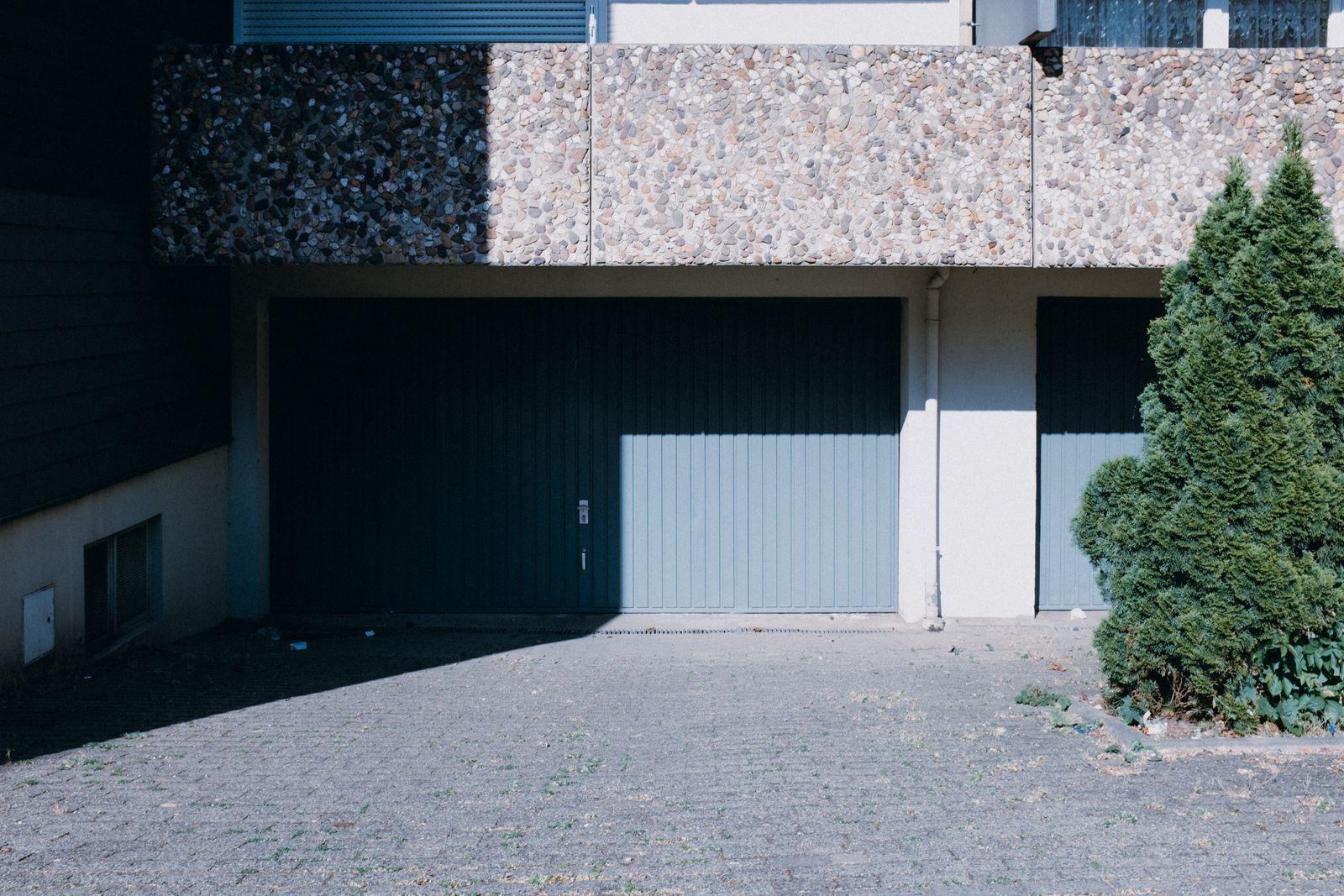
If you only ever take one piece of remodeling advice from me, take this one: before you spend a dollar inside the house, stand across the street and look at your garage door.
On most Fremont, Newark and Union City floor plans, that door is the largest single thing a buyer sees from the curb. It is in the first listing photo, the drive-by, and the memory a buyer carries into the offer conversation. Which is why the humblest project in the entire Cost vs. Value study keeps embarrassing the glamorous ones.
Prefer to watch? Press play below. My video walkthrough runs under nine minutes, including the one comparison that settles the kitchen versus garage door debate.
The numbers, with their year stamps
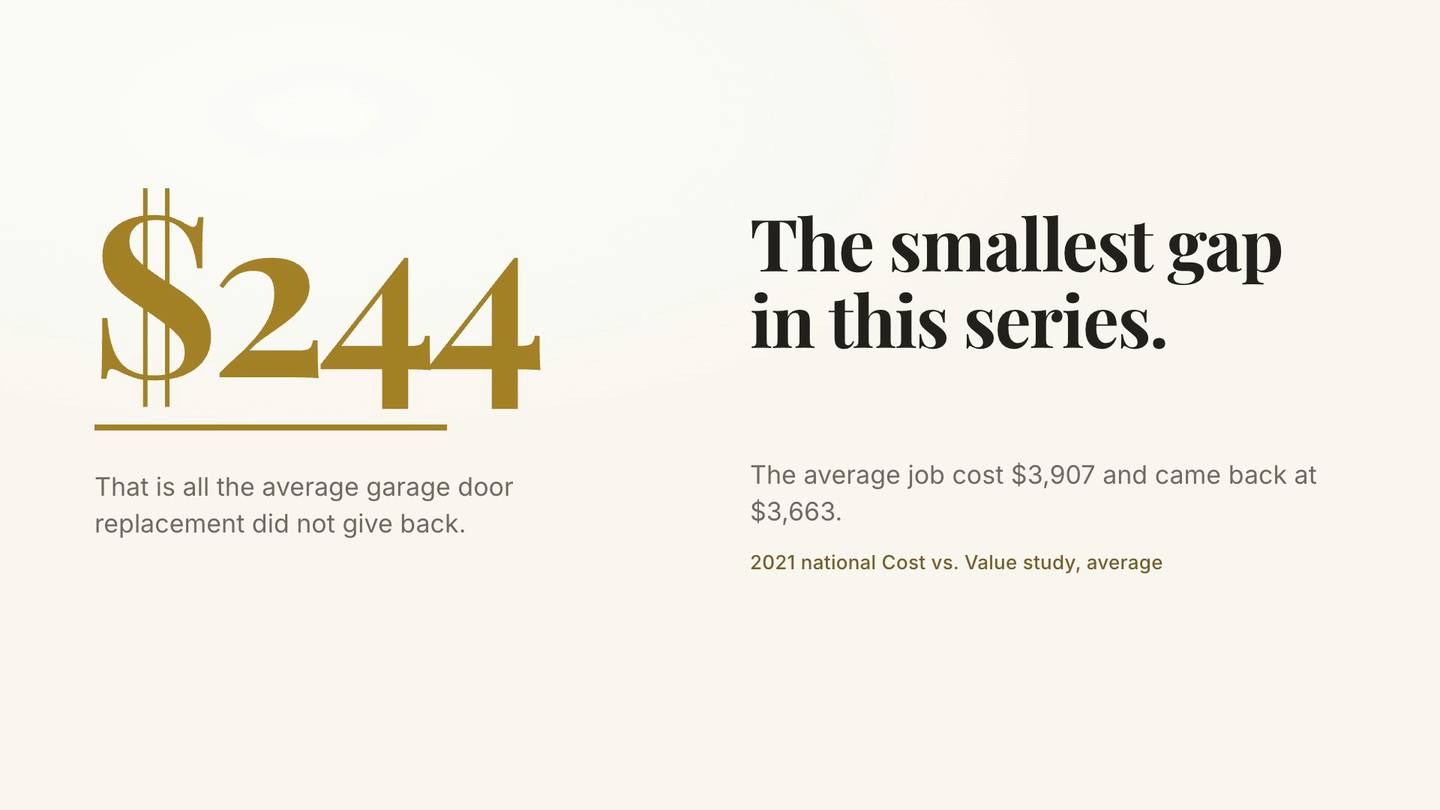
The Kaplan continuing education course that started me down this data trail studied the 2021 report, where a garage door replacement cost 3,907 dollars nationally and returned 3,663 dollars at resale, a 93.8 percent recoup, the highest of any project in that national data. The 244 dollars that did not come back is the smallest gap in this series.
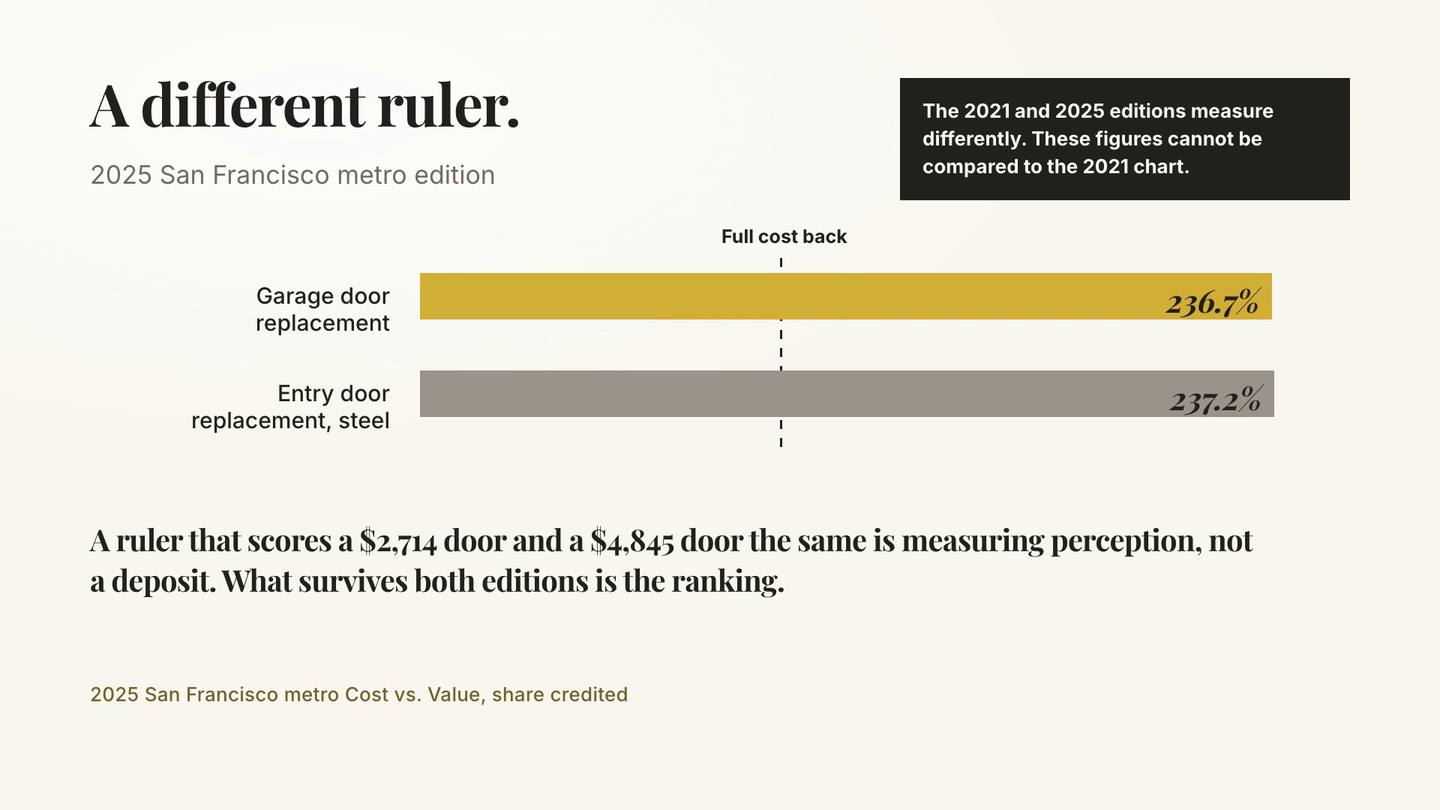
In the 2025 report, a San Francisco metro garage door replacement cost about 4,845 dollars and was credited with about 11,470 dollars at resale, a 236.7 percent recoup.
Garage door replacement: the 2025 payback picture
Source: 2025 Cost vs. Value Report, Zonda Media / Remodeling. San Francisco metro, Pacific region and national data as published at jlconline.com. © 2025 Zonda Media, a Delaware corporation. Percentages are averages for professionally installed projects across a whole metro, and the report's methodology changed between editions, so treat every figure as a planning signal with a year stamp, never a promise for any specific house.
One caution, and I repeat it in every post in this series: the report changed its measurement methodology between those editions, so 93.8 and 236.7 are two different rulers, not a trend line. What survives both rulers is the ranking. In both editions, in the San Francisco, Pacific and national columns alike, this project finishes first or second.
On the 2021 ruler, kitchens and baths left far more behind
Most sellers getting ready to list look right past the garage and start pricing a kitchen or a bath. In that same 2021 national data, a minor midrange kitchen kept 72.2 percent of its cost, a midrange bath 60.1 percent and a major midrange kitchen 57.4 percent. In dollars, the gap ran from 7,287 on the minor kitchen to 32,207 on the major one.
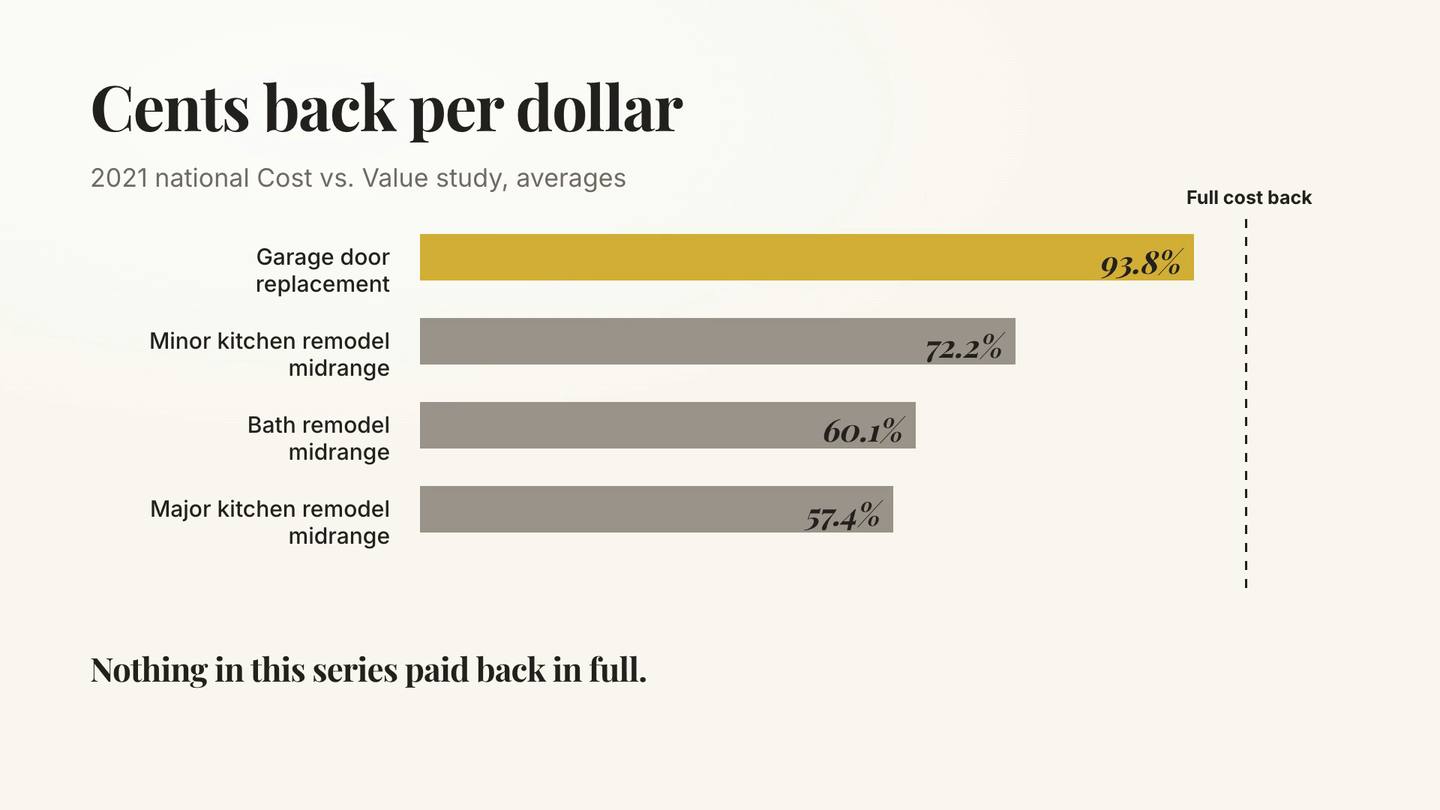
Nothing on that ruler paid back in full, the garage door included, which is why the course's rule is worth remembering: this is return of investment, not return on investment. The 2025 ruler scores things differently, with a minor kitchen at 112.4 percent and a major midrange kitchen at 48.5 percent in the metro data, and those numbers cannot be compared to the 2021 ones.
Rank that 2021 national data by the share of cost recovered and eleven of the top twelve projects are exterior work. The one interior project in the group is the minor kitchen, at number three.
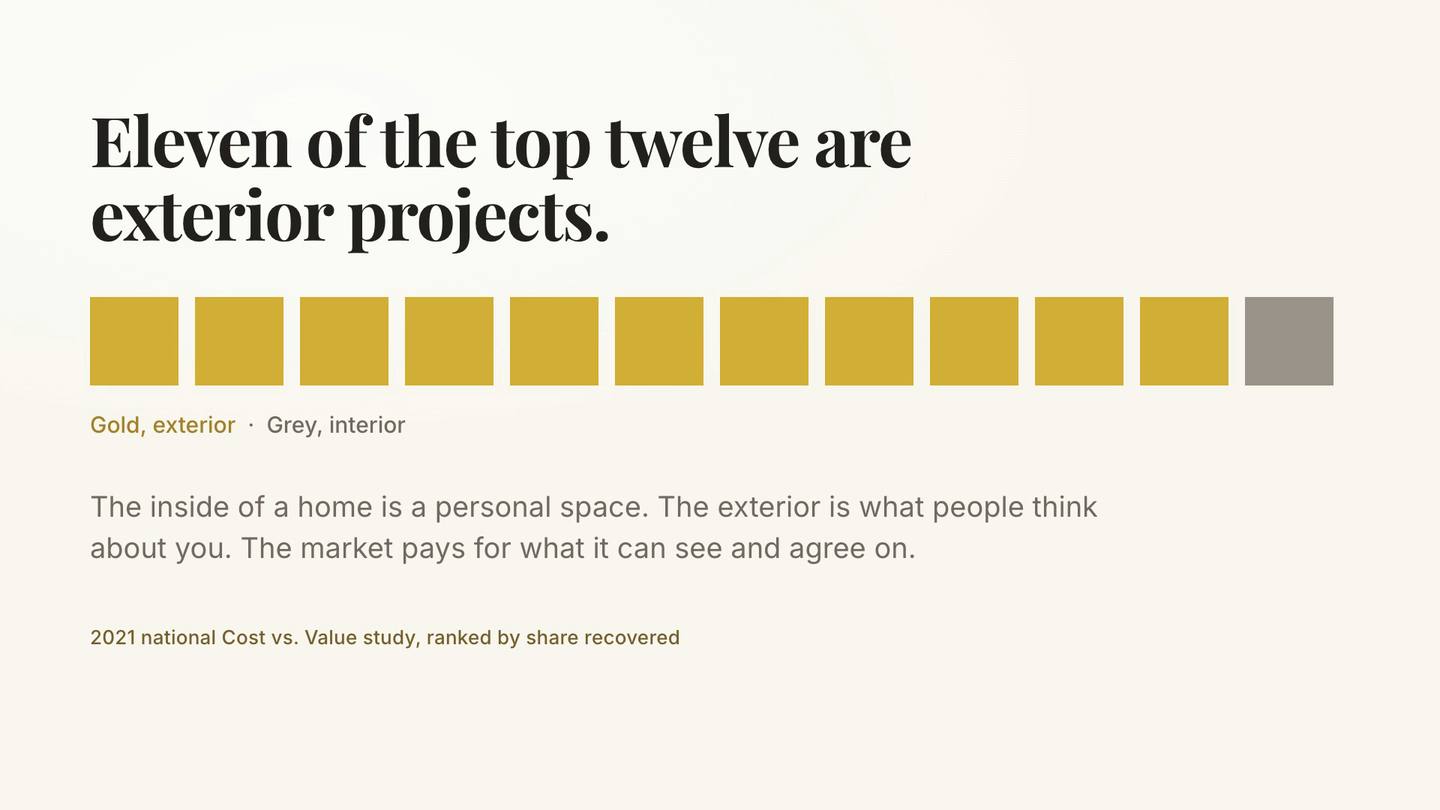
The inside of a home is a personal space, and buyer tastes clash. The outside is market consensus, and the market pays for what it can easily see and agree on.
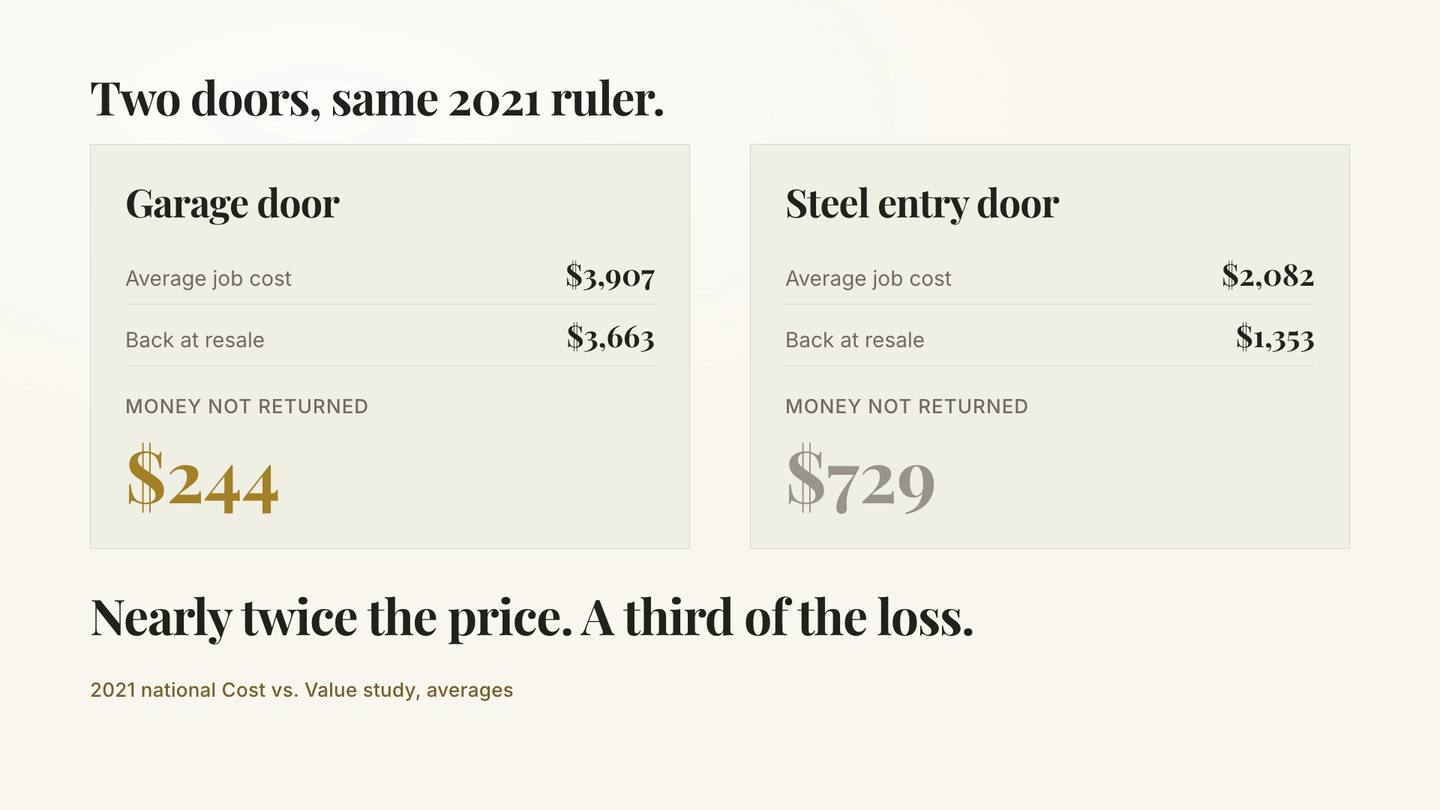
The garage door costs nearly twice as much as a steel entry door and loses a third as much
Its closest exterior rival is the steel entry door. On the same 2021 national ruler, the steel door cost 2,082 dollars and returned 1,353 at resale, a gap of 729 dollars. The garage door cost nearly twice as much and left a gap of 244. A small check does not guarantee a good return. What decides your outcome at the closing table is how much of the check comes back, not how big it was.
The 2025 San Francisco metro edition scores the two almost identically: 237.2 percent for a 2,714 dollar steel door and 236.7 percent for a 4,845 dollar garage door. When one ruler treats two different jobs that way, it is measuring how buyers perceive a house, not a deposit that matches the percentage at the bank. The exact percentages shift with the ruler. The order at the top holds: small exterior projects lead both editions.
What the quoted job actually includes
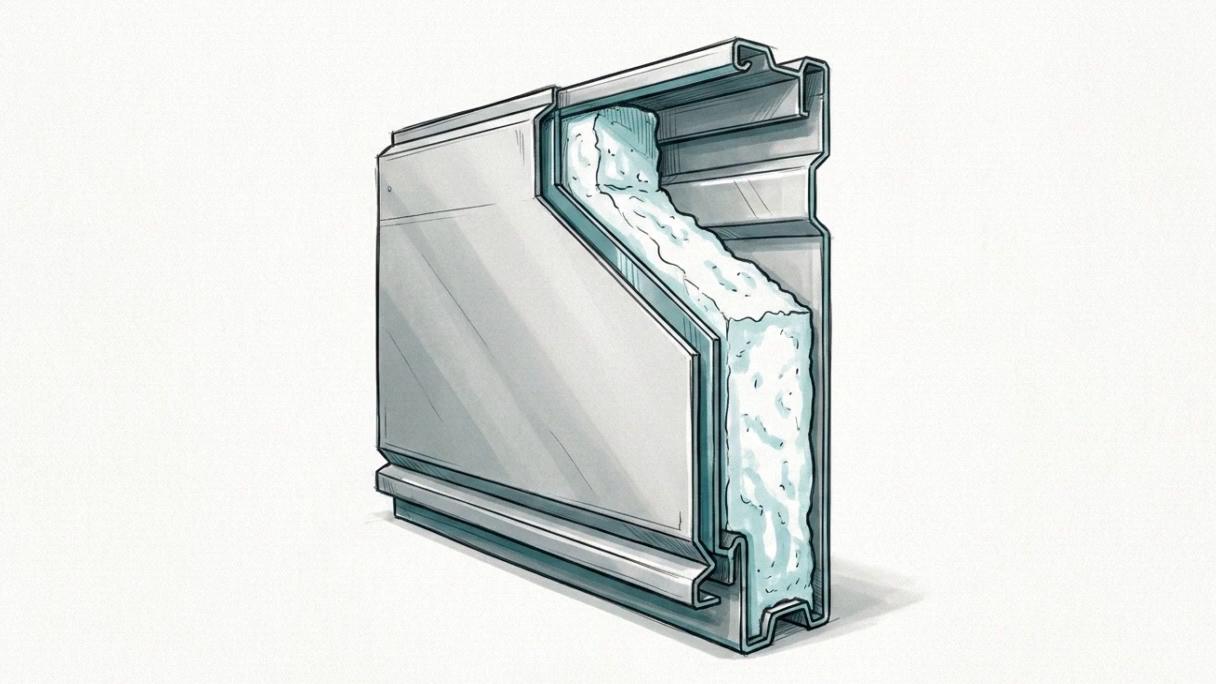
The report prices a professionally installed replacement of a 16 by 7 foot double garage door. The old door and tracks come out, and a new four section door goes in on new heavy duty galvanized steel tracks, reusing the existing motorized opener. The door itself is high tensile steel with two coats of factory paint, foam insulated to at least R-12, with thermal seals between pinch resistant panels and insulated glass windows in the top panel. Hold your quotes against that scope, because a thin uninsulated door is a different job at a different price. Bay Area quotes also run above the national average: the 2021 San Francisco metro figure for the same job was 4,530 dollars.
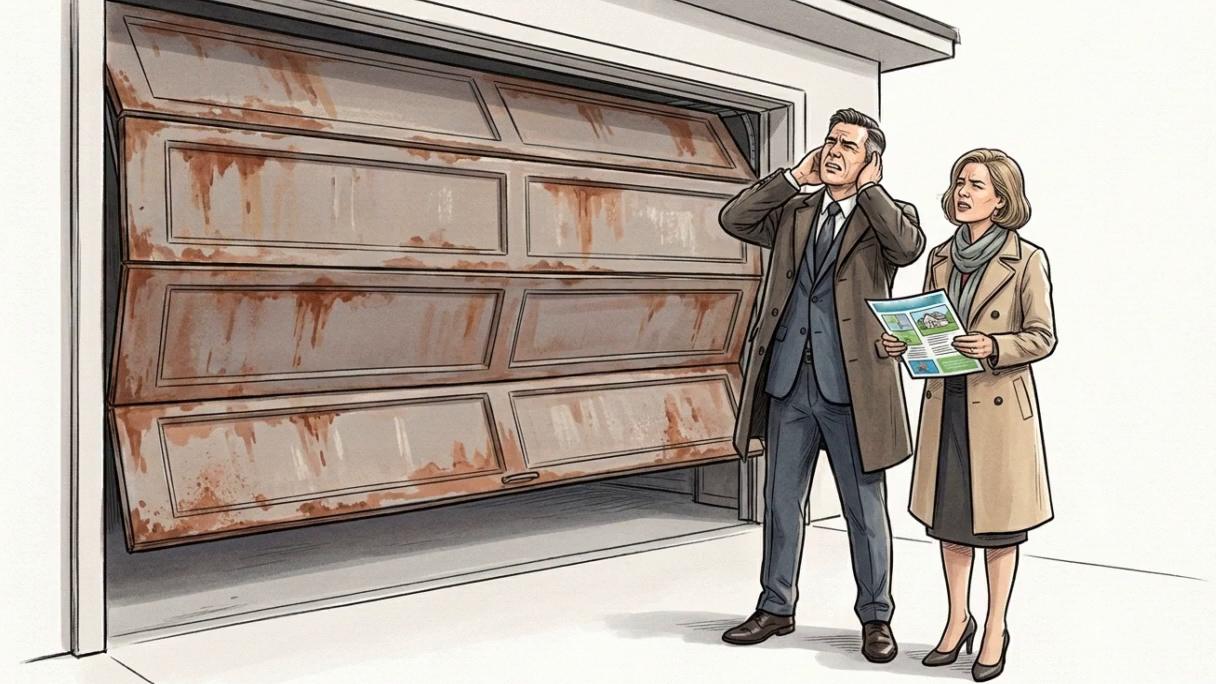
While the installer is there, spend the extra few dollars on quieter nylon rollers. Buyers tour homes midday; a screeching door is a small negative you can delete for almost nothing.
In California, a new door can pull your old opener into the quote
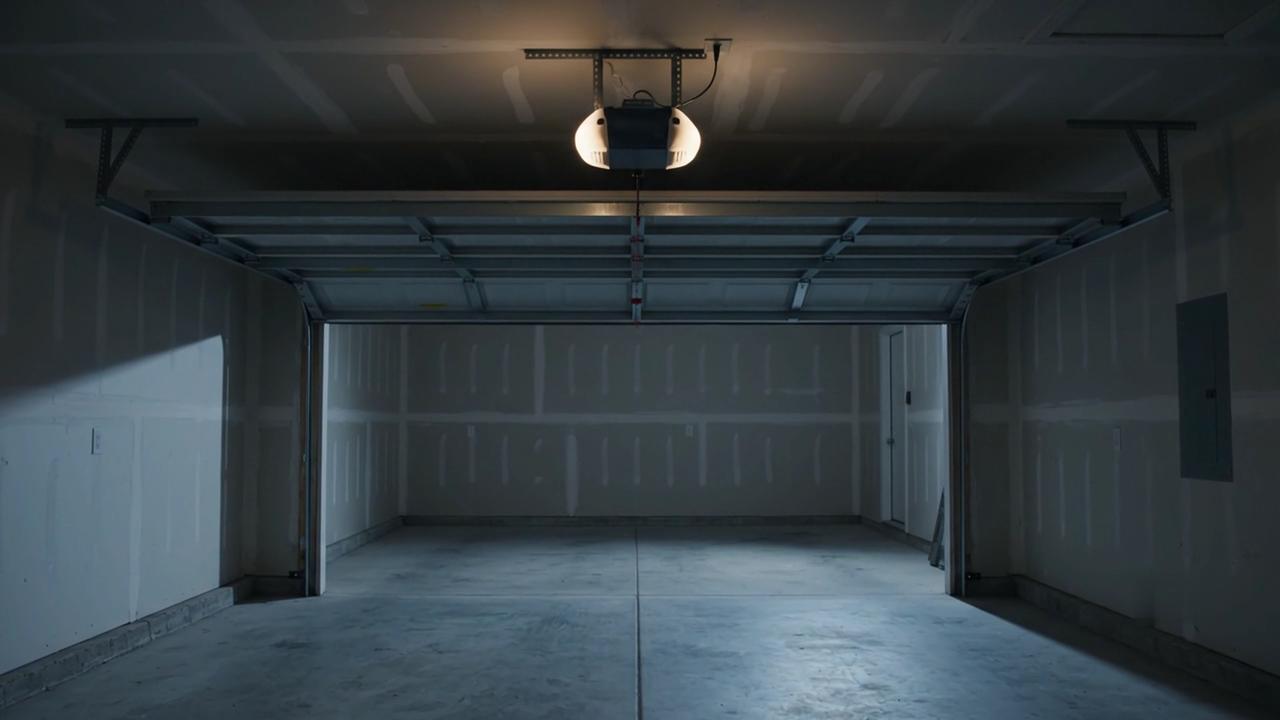
That reused opener is where California changes the job. Since July 1, 2019, SB 969 has barred selling or installing a residential automatic opener without a battery backup, a requirement written after wildfire evacuations failed in powerless garages. The part that matters for this project is that the same section also bars connecting a replacement door to an existing opener that lacks one, no matter how old the opener is. A neighboring section sets the same condition for an opener that fails the auto reverse test.
So before you compare quotes, find out whether your opener has a battery backup and passes that test. If it does, the report's scope fits your house. If it does not, the installer cannot simply reuse it. Depending on the model, a missing battery can be added, while some older openers cannot take one and have to be replaced, and either way that cost belongs in the quote. A battery backup violation carries a civil penalty of 1,000 dollars per opener, and a noncompliant install can surface on a buyer's inspection.
The local wrinkles
Two Bay Area notes. First, insulated doors are worth the modest upcharge here, not for our mild winters but because so many Tri-City garages are semi finished bonus space, gyms and shops, and an insulated panel makes that square footage more usable, which is how buyers actually read a garage.
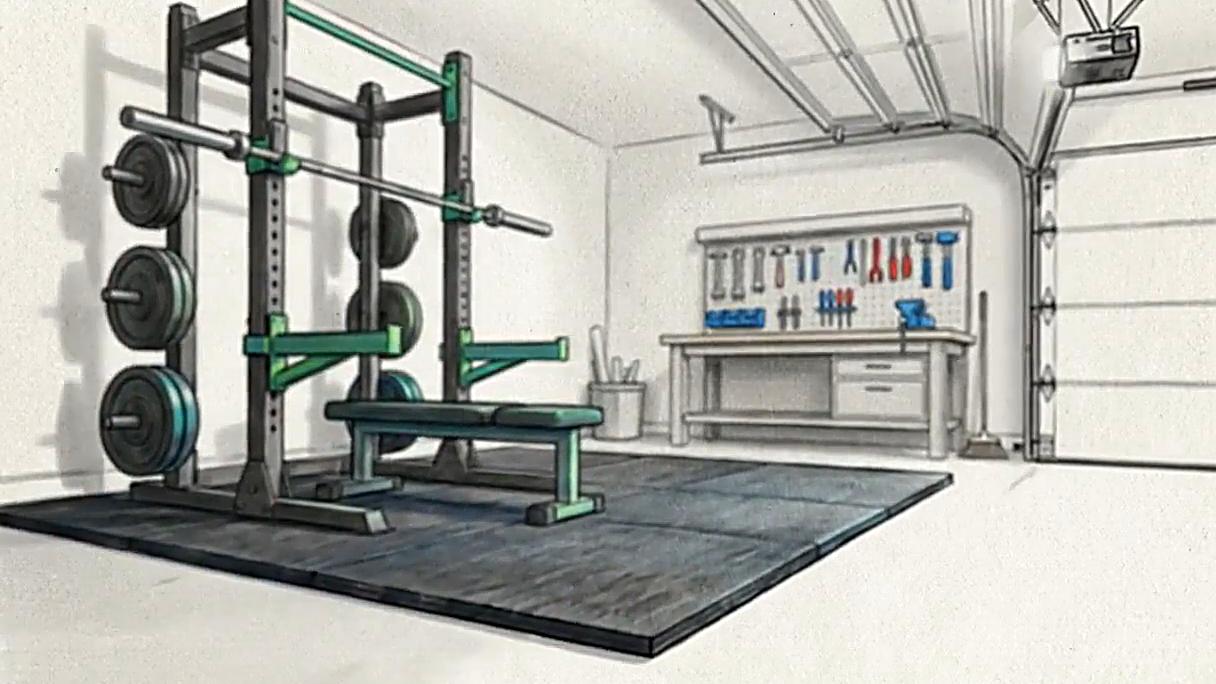
Second, if you live under an HOA, the door style and color likely need approval, and that approval cycle is measured in weeks, so start it before you schedule the installer.
My read, by your timeline
Selling within two years: if your door is dented, dated or noisy, this is the single best pre sale check you can write. It photographs like a remodel and costs like a repair. Pair it with a correctly priced listing and you have captured most of what cosmetic prep can do.
Staying a while: do it whenever the old door starts failing, and enjoy the quiet. This is one of the few projects where waiting costs you nothing, because the payback shows up whenever you eventually sell.
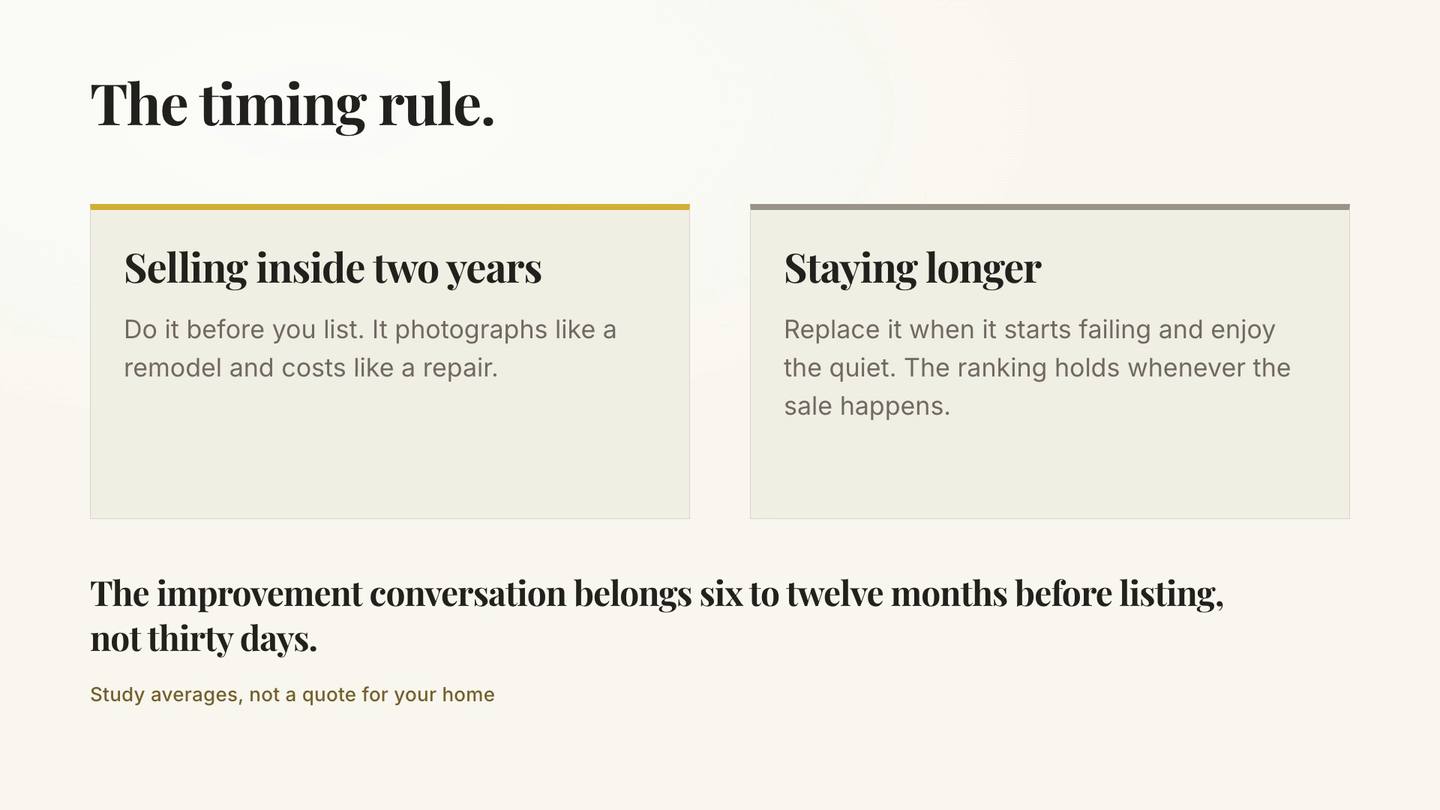
Either way, start early. The improvement conversation belongs six to twelve months before your home goes on the market, not thirty days before, because association approvals and supply lead times need a runway. These are published averages for the specific job studied, not a quote for your house or a promise about your street. If a sale is on your horizon, I will walk your home with you and tell you which projects are worth doing and which are not.
Run your own quote through the checker below, then see how this project compares to the other nineteen in this series or its closest cousin, the steel entry door.
What would this garage door replacement quote get back?
I apply the 2025 San Francisco metro recoup average for this project, about 236.7 percent, to your real number. A planning picture before you sign, not a valuation.
On the 2025 San Francisco metro average, this project carries its own cost and then some. Timed just before listing, it is one of the few checks that can come back larger than it went out.
A planning illustration, not a valuation, appraisal or promise of any outcome. It applies one published metro average (2025 Cost vs. Value Report, Zonda Media / Remodeling, San Francisco metro) to the number you typed, nothing more. Whether a specific project pays on your specific house depends on condition, block and timing; that conversation belongs in a pre listing consult with real comparable sales.
Sources
- Cost vs. Value Report 2025, San Francisco metro (Zonda Media / Remodeling): jlconline.com/cost-vs-value/2025/pacific/san-francisco-ca
- Cost vs. Value Report 2021, national averages: jlconline.com/cost-vs-value/2021
- Cost vs. Value Report 2021, San Francisco metro: jlconline.com/cost-vs-value/2021/pacific/san-francisco-ca
- California Health and Safety Code, automatic garage door openers: section 19892, battery backup, section 19890, auto reverse, section 19891, penalties
- California Assembly Housing Committee analysis of SB 969 (June 2018): ahcd.assembly.ca.gov
Harv Balu, REALTOR®
- Cell / Text: (510) 600-3425
- Email: homes@HarvRealtor.com
- Web: HarvRealtor.com
- REALTY EXPERTS®, 41051 Mission Blvd, Fremont, CA 94539, DRE# 02195792
Disclosures
This information is educational and general in nature and is not a bid, valuation, appraisal, or guarantee of any outcome. Cost and resale figures are published averages from the Zonda Media and Remodeling magazine Cost vs. Value Report, cited by edition year and geography in the text, current as of August 2026; the report's methodology changed between editions, so figures from different years are not comparable. Building code and legal notes describe general California practice; verify current requirements with your local building department and licensed professionals before contracting work. Equal Housing Opportunity. Information deemed reliable but not guaranteed.
About the images: the header image is a stock photograph. The other pictures in this post come from my video on this topic. The data cards are drawn in code from the published Cost vs. Value averages, the photo style scenes are stills from AI clips generated with Google Veo, and the sketch style illustrations are AI images from Google NotebookLM. None of them shows a real home, a listing or a project from the Cost vs. Value study.
Garage door questions sellers actually ask
How much value does a new garage door add when selling?
In the 2025 Cost vs. Value Report, a garage door replacement in the San Francisco metro cost about 4,845 dollars and was credited with about 11,470 dollars of resale value, a 236.7 percent recoup on the metro average. The report changed how it measures value after its 2021 edition, when the same project recouped 93.8 percent nationally, so those are two different rulers, not a trend. Either way it is an average across many homes, not a promise for yours, but the direction is consistent: on a typical Tri-City home the garage door is a huge share of the street-facing facade, so replacing a dented or dated one upgrades most of the first photo buyers see for the price of a paint job.
Does California require anything special when replacing a garage door or opener?
Yes. Since July 1, 2019, California law has barred selling or installing a residential automatic garage door opener without a battery backup, so the door still operates during a power outage. The same section, from SB 969, also bars connecting a replacement door to an existing opener that lacks one, no matter how old the opener is, so even a door only job can pull the opener into your quote. The rule exists because people were trapped during wildfire evacuations when the power failed. Ask whether your current opener has battery backup before you compare bids, because a noncompliant install can surface during inspections and it is an easy thing to get right the first time.
Should I replace the garage door before listing my house?
If the current door is dented, rusted, sagging or visually dated, it is one of the first things I flag in a pre listing walkthrough, because it is a modest check that changes the entire curb photo. If the existing door is clean and operates smoothly, keep your money; a functional door in good condition does not need to be new. The honest answer comes from standing at the curb and looking at your house the way a buyer scrolling listings at 11 pm does.
How much does a garage door replacement cost in the Bay Area?
The 2025 Cost vs. Value Report puts a San Francisco metro replacement at about 4,845 dollars for a 16 by 7 foot insulated steel door on new tracks, reusing the existing opener. That is a published average for one specified job, not a quote. Door style, windows and whether your opener needs a battery backup or a replacement will all move your number, so get two or three local bids against the same scope.

Harv Balu
REALTOR® | GRI, CIPS, PSA, FTBS · REALTY EXPERTS®
CA DRE# 02195792
Read every post in HarvRealtor, my free app, and the words read offline. Download it free from the App Store® (opens in new tab) or Google Play™ (opens in new tab).