Newark's First-Time Buyer Program Is Taking Applications. Here's How I'd Use It.
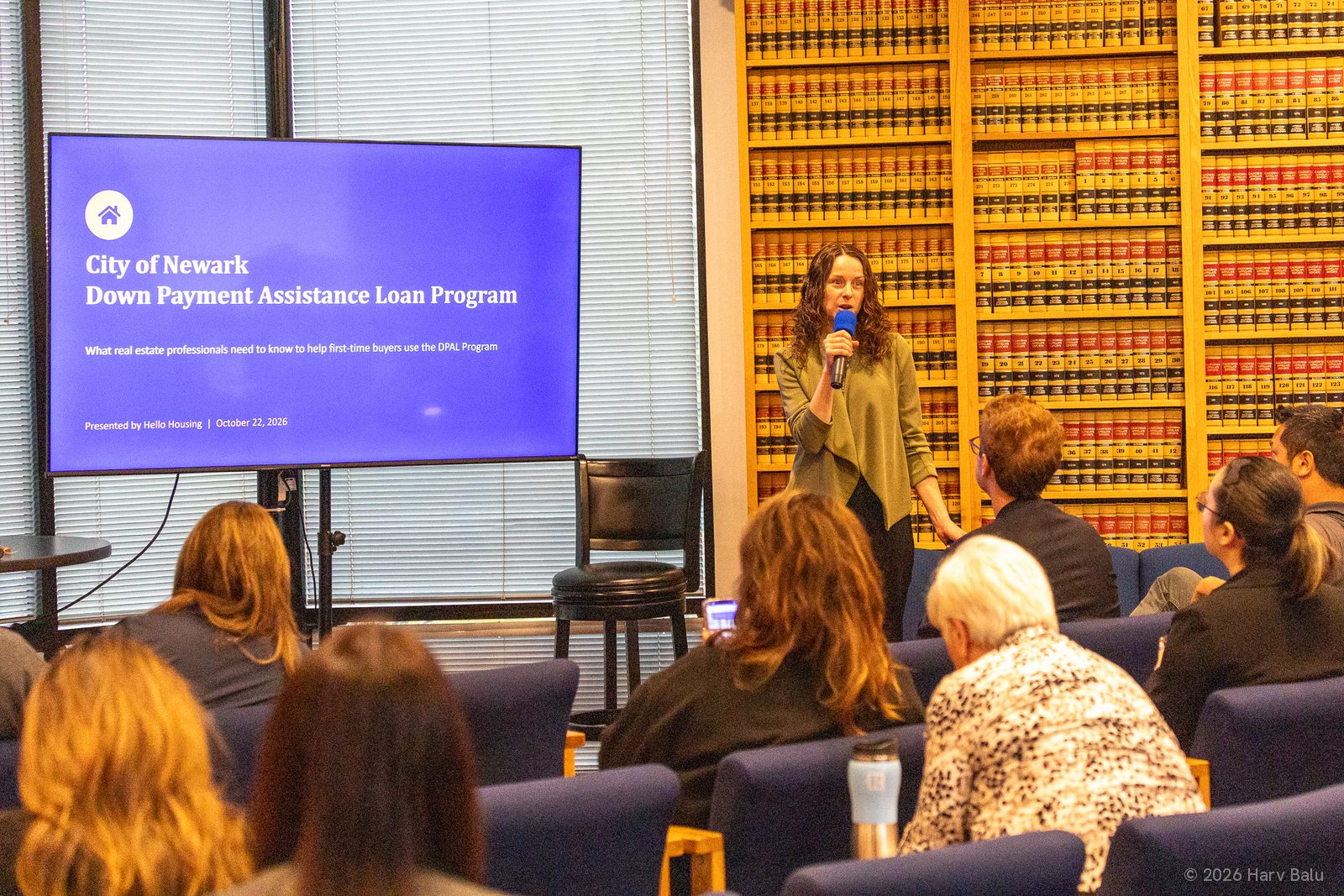
I'm on the Tri-Cities Marketing Council committee, and on Thursday, October 22, 2026 our guest speaker was Sarah Shimmin, a senior program manager at Hello Housing. Hello Housing is the nonprofit running Newark's first-ever down payment program for first-time buyers, the City of Newark Down Payment Assistance Loan Program, and by the time Sarah stood up, the pre-application had been open for about a week. I took the photos, and they're further down this post, dealt out as raffle tickets.
A month earlier, Newark's mayor told our council the program was on its way, and I wrote about what it is and what it could mean at Newark prices. This post picks up where that one stopped. Sarah's talk was about the mechanics: who gets in, in what order, and what changes when a buyer using the city's money writes an offer. The council's own recap is on the Tri-Cities Marketing Council blog, and her talk starts at 32:18 in the meeting recording. What follows is my read as an agent who works with buyers and sellers in Newark, checked against the program's guidelines and implementation manual.
The short version
- Up to $200,000 toward a first-time buyer's down payment on a Newark home, with no monthly payment. At a sale or after 30 years you repay it plus the larger of 3 percent simple interest or the city's share of any gain in value.
- Pre-apply by January 8, 2027 at 5 PM. The form takes a few minutes and asks for no documents.
- It's a lottery, not first come, first served, and people who have rented or worked in Newark for six months or more are ranked ahead of everyone except households displaced by a proposed residential project.
- The odds are tight. Sarah put this first round at about $4 million and counted roughly 150 pre-applications in the first week.
- Offers work differently. At least 35 days of escrow, required inspections, and seller credits only toward closing costs.
The calendar that decides this round
Here's what I take from that calendar. A household with a good lottery number that's approved in late February or March would be shopping through the spring of 2027, usually the most competitive stretch of the year here, with a 120-day clock running. The manual lets you ask in writing, at least five business days before the 120 days end, for a 30-day extension if you can show you've been looking in earnest, such as two offers that weren't accepted, but it says a thin market and competing offers on their own don't count as extenuating circumstances. That's why I want the groundwork done before the lottery, not after it.
Do the math on the odds before you count on it
Sarah estimated this first round's funding at about $4 million. When the City Council approved the program in May, the amount was $3 million, so ask Hello Housing for the current figure. If every household borrowed the full $200,000, $4 million would cover 20 purchases; smaller loans stretch it a little further. Against roughly 150 pre-applications in the first week, with the outreach still going, plenty of eligible households won't get a turn this round. Sarah added that Hello Housing would like to see the program keep going after these funds are spent.
So I'm telling clients two things. Apply, because the pre-application costs nothing and the upside is large. And keep a plan that works without it, like buying with less than 20 percent down through a regular loan (my post on buying with less than 20 percent down covers the options), so a lottery number isn't the whole strategy.
Living or working in Newark moves you up the list
The lottery ranks households at random, but inside three groups, taken in order:
- Displaced: someone who will be on title had to leave a Newark rental because a residential project was proposed on the site.
- Live or work in Newark: someone who will be on title rents a home in Newark or works in Newark, and has done so for six months or longer by the time of the pre-application.
- Everyone else who is eligible.
The definitions are stricter than "I'm in Newark a lot." Living in Newark means renting a home inside the city limits, shown with a lease, a driver's license with that address, a car registration or utility bills, along with proof of six months of rent. Working in Newark means your primary source of income comes from a Newark employer licensed by the city at a worksite in Newark, or from a Newark-based business of your own that the city has licensed. Someone asked Sarah whether working in Newark once or twice a week counts; she believed the primary job had to be there, and the guidelines read that way. If you work from home, your employer needs a licensed place of business inside the city.
Claiming a preference you can't prove costs you, too: you lose your lottery number and drop to the bottom of the group you actually qualify for. For clients who rent in Newark, I'm asking for the lease and six months of rent records now, before they pre-apply.
Who I'd tell to pre-apply this week
Sarah's screening slide is in the photos below. The guidelines fill in the detail:
- Three years without owning: none of the household members can have owned their own residence, in any state or country, during the past three years. A home owned with a former spouse, a timeshare, or cosigning someone else's loan doesn't count against you.
- Income at or below 120 percent of the Alameda County median, with the income of every adult moving in counted. The table is just below.
- Assets up to $225,000 when you apply. You can keep up to $60,000 after closing, and anything above that goes into the purchase. Retirement accounts you could draw on while still working count, even with a penalty; 529 college savings accounts don't.
- Homebuyer education: 8 hours of HUD-certified classes for every adult going on title, with a certificate dated within 12 months of the application.
- Housing costs of at least 28 percent of income, and all debts no more than 45 percent. The 28 percent floor is the city's test that you need the help, and it surprises people: a household with a high income compared with the home it's buying may not pass it.
- You live there. At least ten months a year, no renting out any part of the home without the city's written approval, and never as a short-term rental. The city checks every year.
- At least one person per bedroom. A two-bedroom home needs a household of at least two, a three-bedroom at least three. A bonus room that meets the program's bedroom test counts as a bedroom, whatever the listing calls it.
The 2026 income limits by household size
These are California HCD's 2026 State Income Limits for Alameda County, effective June 23, 2026, which the program's guidelines use. Sarah's chart showed the same 120 percent column. The limits change every year, and Hello Housing makes the final call on a household's income. One caution: the guidelines and Sarah's slide put the $200,000 tier at 100 percent of the median, and so does Hello Housing's Newark page, but the eligibility page it links to still says 80 percent (checked November 9, 2026). Confirm which applies with Hello Housing before you count on the larger amount.
What changes when my buyer writes an offer
This is where the program touches my day-to-day work, and where a buyer could lose the money by accident.
- Escrow of about 45 days. The program's minimum is 35 calendar days, but they count from when the contract reaches Hello Housing, the lender has up to five business days to send it, and the inspection reports and homebuyer class certificate are due 12 business days before closing. So I'd write about 45 days and tell the listing agent why up front. And an escrow that stretches beyond 60 days can be given a hard closing deadline by the city.
- Pick a lender who has closed these. The first mortgage must be fixed-rate, 30 years or shorter and fully paid off over its term, and adjustable rates, balloon payments and negative amortization are all ruled out. The first loan must also equal at least 50 percent of the price. Together the loans can reach 100 percent of the value. The pre-approval letter must name every borrower and show the maximum price, the first loan and the city's loan, and after the contract the lender has five business days to send its package to Hello Housing. Your lender doesn't have to come from a list, though Sarah said Hello Housing is assembling one of lenders who know the program.
- Two inspections, no exceptions. The buyer needs a general home inspection plus a wood-destroying pest report dated within 90 days of when it's turned in. Health and safety problems and code violations have to be fixed before the city funds, a repair holdback of up to $10,000 is possible at the city's discretion, and the city can turn a home down because of its condition. For a buyer using this program, a true fixer is a hard fit.
- Credits go to closing costs only. The city's money pays only toward the down payment, never closing costs, repairs or a rate buydown. Seller, agent and lender credits can cover non-recurring closing costs, but the buyer can take home no more than $250 in cash at closing, and anything over that reduces the city's loan. I size credits to the lender's closing cost estimate.
- The home has to qualify. Inside Newark city limits: a house, townhome or condo, a live/work unit, an accessory dwelling unit sold separately as AB 1033 allows, or a below-market-rate home priced for households at or below 80 percent of the median. Duplexes and other multi-unit buildings are out, and so are tenancy-in-common units, sales where the buyer has a connection to the seller or anyone else in the deal unless the city approves, homes where a tenant was unlawfully evicted, and new construction without a certificate of occupancy when the contract is signed. The guidelines set no maximum price.
- Two paperwork extras. The city gets an ALTA lender's title policy of its own, and the homeowners insurance has to list the city as loss payee or additional insured. For a condo or townhome whose HOA policy doesn't cover the interior, that means a separate HO-6 policy that names the city.
If you're selling in Newark, read the offer for these
The program brings a new group of first-time buyers to Newark, and most of them will be shopping in the spring. If I'm listing a Newark home and an offer arrives with the city's loan in it, here's what I check:
- The approval letter. Ask the buyer's agent for the conditional approval and its date. Sarah said reserved funds are earmarked for that buyer, but final approval still depends on the home, the inspections and the buyer's updated income, so I'd treat it like any other financing contingency.
- A closing date that fits the program. A short escrow won't work. With the lender's package and the buyer's 12-business-day document deadline, I'd expect about 45 days. Agree on a realistic date at the start rather than extending later.
- Repairs before funding. Health and safety items have to be fixed before closing, so talk early about who handles them and when, especially active pest damage listed in Section 1 of the report.
- The appraisal. The loans together can't exceed 100 percent of the lower of the price or the appraised value, so if the appraisal comes in short, the buyer brings cash or the price moves. It's the same conversation as any other offer, with less room in it.
A buyer using the program isn't a weaker buyer, in my view, just one on a longer, more documented path. Priced and timed for it, these offers can close.
How the payback works, in one example
There's no payment while you own and live in the home. When the loan comes due, after 30 years or sooner at a sale, a transfer or a refinance the city didn't approve, you repay what you borrowed plus whichever is larger: 3 percent simple interest per year, or the city's share of the gain in value, plus a payoff fee. The city's share matches the slice of the purchase price its loan covered.
Sarah used the program's own example. Buy a $500,000 home with $100,000 from the city, 20 percent of the price, and sell it five years later for $635,000. The city's 20 percent of the $135,000 gain is $27,000, and five years of interest would be $15,000. The larger one applies, so the payoff is $127,000. If the home hasn't gained value, you still owe the interest. The city uses the higher of your sale price or an appraisal, and refinancing the first mortgage needs its written approval. My earlier Newark post runs the same rule at a million-dollar Newark price.
What Sarah told the room in the Q&A
- What if the money runs out during my 120 days? Once you hold a reservation, she said, those funds are earmarked for you. The manual adds that conditional approval isn't final approval and still depends on available funds.
- How many people have applied? Roughly 150 households in the first seven days, she said, most of them in a rush whenever the interest list got an email.
- Is anyone else offering this? Emeryville and Concord have programs, she said, perhaps Antioch as well. Alameda County's AC Boost, another Hello Housing program, wrapped up its first round and isn't accepting applications right now. The guidelines let the city's loan sit behind another down payment loan, at the city's discretion, when that other loan is larger than the city's, so ask your lender what can be combined.
What I'm doing for buyers before January 8
- A quick screen against the list above, so nobody spends a month on a program they can't use. Hello Housing decides eligibility; I want my clients to walk in knowing where they stand.
- Pre-applying early, and putting January 20 on the calendar the same day.
- Starting the homebuyer class now, so the certificate is ready before anyone asks for it.
- Connecting buyers with lenders who have closed purchases alongside city or county assistance, for a pre-approval that shows the city's loan.
- Building a Newark home search around what the program allows: eligible home types inside city limits, with bedroom counts the program's occupancy rule permits, while my buyers decide which homes they want to see.
- Keeping a plan B, so a lottery number doesn't decide whether a client buys a home in 2027.
The rest of the morning
Three first-timers introduced themselves: Venson Burnside, a mortgage lender, Jasmine Sandoval, licensed for about two weeks, and Parul Arora of Compass. Susan Munkner brought the market numbers, with the average 30-year rate at about 7.4 percent, down from a peak near 7.6, and purchase applications running 18 percent below a year earlier. Her advice was not to sell a loan on rate alone, and to weigh mortgage insurance against a higher rate without it before choosing. Mollyanne Sherman, joined by Jackie and Terri Thiel, handed out gift tags for Adopt-an-Angel, which gathers holiday gifts for foster children and for children from low-income households. Then Val drew last week's Super Tour winner from the basket and found her own name on it.
The morning, one ticket at a time
Fitting for a program that picks its applicants by lottery, and a morning that ended with a drawing: here are my photos from October 22 as raffle tickets. Open any one, or spin the drum and let it pick.
Roll ASign-inNos. 01 to 03
Roll BNew facesNos. 04 to 07
Roll CMarket checkNos. 08 to 10
Roll DHello HousingNos. 11 to 15
Roll EThe detailsNos. 16 to 18
Roll FFrom the floorNos. 19 to 20
Roll GGood causesNos. 21 to 23
Roll HThe drawingNos. 24 to 25
Photographs by Harv Balu. Select a ticket to open it, or let the drum draw one; the arrow keys move between them.
Thank you, Sarah
Thank you, Sarah, and everyone at Hello Housing, for showing our council the program this early and for answering every last question. Our council meets Thursday mornings in Fremont and welcomes guests, and the council's speaker calendar shows who's next. For Newark itself, my Newark city guide has the basics, and what Newark homes sold for in September is my latest read on prices.
If you rent or work in Newark and you've been waiting for a way to buy, call or text me at (510) 600-3425 or email homes@HarvRealtor.com before January 8, and we'll go through the list together. If you own in Newark and want to know what these buyers could mean for your sale, a home value estimate is a good place to start.
Harv Balu, REALTOR®
- Cell / Text: (510) 600-3425
- Email: homes@HarvRealtor.com
- Web: HarvRealtor.com
- REALTY EXPERTS® · 41051 Mission Blvd, Fremont, CA 94539 · DRE #02195792
Disclosures
This post is general information. It isn't lending, legal or tax advice, it doesn't offer credit, and it can't promise anyone will qualify. Harv Balu is a REALTOR® and California real estate licensee, not a lender or housing counselor, and does not administer the program; Hello Housing and the City of Newark decide eligibility. Program details come from Sarah Shimmin's presentation to the Tri-Cities Marketing Council on October 22, 2026, and from the June 23, 2026 edition of the program guidelines and the implementation manual. Dates, funding, income limits and rules can change, and the program's own documents have the final word. Income limits are California HCD's 2026 State Income Limits for Alameda County. The market numbers are Susan Munkner's from that morning. Sarah Shimmin and Hello Housing did not review this post, and no lender or company mentioned is an endorsement.
Photographs © 2026 Harv Balu, taken at the meeting.
Equal Housing Opportunity. Harv Balu, CA DRE #02195792. REALTY EXPERTS® (CA DRE #00414413) is independently owned and operated. © 2026 Harv Balu, REALTY EXPERTS®.
Applying for Newark's first-time buyer program: common questions
What is the deadline to apply for Newark's down payment assistance program?
Pre-applications for Newark's down payment assistance loan close January 8, 2027 at 5:00 PM. It's a short online form on Hello Housing's Newark page and asks for no documents yet. Anyone who passes that first screen receives an ID number by email and an invitation to a required online workshop on January 20, 2027, and skipping the workshop means no lottery entry. The lottery is the week of January 25. Households are then invited in lottery order to send a full application, and each has 30 calendar days to complete it.
Who gets priority in the Newark down payment assistance lottery?
The lottery ranks applicants at random inside three priority groups. First are households displaced from a Newark rental by a proposed residential project. Second are households where someone who will be on title rents a home in Newark or works in Newark, and has for six months or more before pre-applying. Working there means your main income comes from a Newark employer or a Newark-based business licensed by the city, at a worksite in the city. Every other eligible household lands in the third group. Claim a priority you can't document and you lose your lottery number and move to the bottom of the group you do qualify for.
Can seller credits be used with Newark's down payment assistance loan?
Yes, toward closing costs. The city's loan pays only toward the down payment, not closing costs, repairs, rate buydowns or debts. Credits from the seller, an agent or the lender can cover non-recurring closing costs, the buyer can receive no more than $250 in cash at closing, and anything above that first reduces the city's loan. That's why I size a credit to the lender's closing cost estimate instead of picking a round number.
How long does escrow take with the Newark down payment assistance loan?
The program's minimum is 35 calendar days, counted from the day the purchase contract reaches Hello Housing rather than from acceptance, so I'd write about 45. It needs that time because Hello Housing and the city review the lender's package, the inspections and the final figures before the city sends its money to escrow. The lender has five business days after the contract to send its package, and the city may impose a closing deadline on any escrow longer than 60 days. The buyer also needs a general home inspection and a pest report no more than 90 days old, with health and safety repairs finished before funding.

Harv Balu
REALTOR® | GRI, CIPS, PSA, FTBS · REALTY EXPERTS®
CA DRE# 02195792
Read every post in HarvRealtor, my free app, and the words read offline. Download it free from the App Store® (opens in new tab).