The Fed Just Raised Rates for the First Time Since 2023. Here Is What It Actually Means for Bay Area Buyers and Sellers
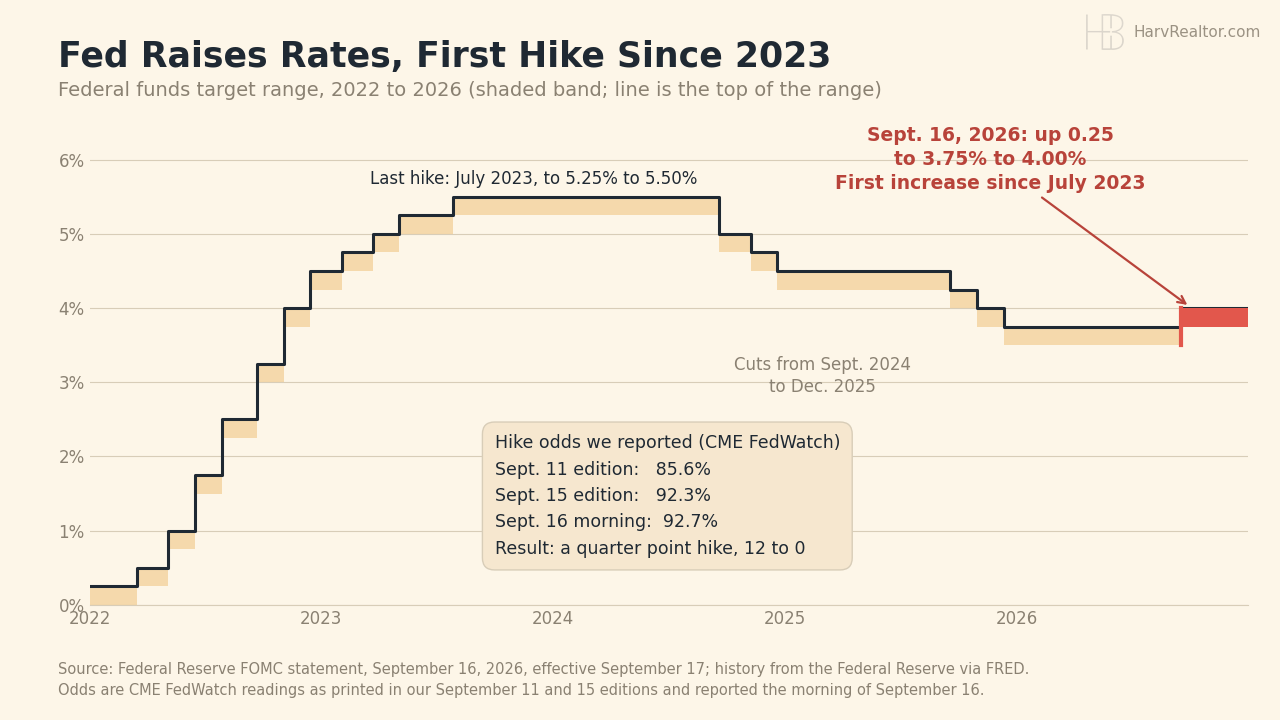
At 11 AM Pacific this morning, the Federal Reserve raised its target rate a quarter point, to 3.75% to 4.00%, on a 12 to 0 vote. It is the first increase since July 2023. If you felt a small tremor around 11:01, that was not the Hayward Fault. That was every loan officer in the Bay Area refreshing their rate sheet at the same moment.
It was also the least surprising surprise of the year. Our daily report had the odds at 85.6% last Thursday and 92.7% this morning. So instead of a wall of text, this post is mostly pictures you can tap: what the Fed did, why, what it does to your mortgage (less than you think), and what it costs in real Fremont dollars.
What the Fed did, and where it says it is going
The statement is short, and two sentences carry it: "Inflation remains elevated. Today's policy action will support a timelier return to the Committee's 2 percent goal." Chair Kevin Warsh put it plainly at the press conference: "The plain fact is that inflation is too high and has been for too long."
The projections matter more than today's quarter point. Tap the markers below: the typical Fed official now sees the rate at 4.1% at the end of 2026 and again at the end of 2027, up from 3.8% and 3.6% in June. One more hike this year, then a long hold. The full statement and projections are on the Fed's site, and both are shorter than this post.
The Fed's own forecast, median official
One more hike this year, then a long hold
September projection, end of 2026: 4.1% (June said 3.8%)
Federal Reserve, Summary of Economic Projections, median projection for the federal funds rate at year end, September 16, 2026 and June 17, 2026 meetings. Federal Reserve projections are not forecasts of mortgage rates.
Why now: inflation is stuck, and one line is doing most of the damage
The Fed's preferred gauge, the PCE index, ran 3.7% in July against a 2% goal, with oil back above $100 a barrel. Here at home, the Bureau of Labor Statistics has Bay Area prices up 3.4% over the year to August. Look at which bar is long. If your PG&E bill and your gas receipt have felt personal lately, it is not your imagination.
Bay Area prices, twelve months to August 2026
One category is doing most of the damage
U.S. Bureau of Labor Statistics, CPI-U for San Francisco-Oakland-Hayward, percent change over the 12 months ending August 2026, released September 11, 2026. The dashed line is the Federal Reserve's 2% inflation objective, which is set on the national PCE index, shown here as a reference.
The part most headlines get wrong: the Fed does not set your mortgage rate
Your 30-year mortgage is priced off the 10-year Treasury yield, which closed at 5.00% on Tuesday, its first close at 5% since July 2007. It moves on what investors expect inflation to do over a decade, not on what the Fed did at 11 AM. The bond market is like a hot Bay Area open house. By the time the news trucks show up, the people who matter have already written their offer.
Tap the four moments below. In September 2024 the Fed cut by a half point, and mortgage rates went up almost a full point over the next four months. Today's hike was in the price before the Fed spoke: Mortgage News Daily had the 30-year at 7.19% this morning, three basis points under Tuesday's one-year high.
Two lines, four moments
The Fed's rate and your mortgage rate are not the same line
Sep 2026: Today's hike, the first since 2023
What the Fed did
Up a quarter point, to 3.75% to 4.00%, effective September 17.
What mortgages did
7.19% on the morning of the decision (Mortgage News Daily), three basis points under Tuesday's one-year high.
Already in the price before the Fed spoke.
| Moment | Fed | Mortgage |
|---|---|---|
| Mar 2022, The first hike of the last cycle | Target range up a quarter point, to 0.25% to 0.50%. | 30-year fixed 3.85% on March 10, 5.11% by April 21. Up 1.26 points in six weeks, most of it before the Fed moved. |
| Jul 2023, The last hike, to 5.25% to 5.50% | Top of the cycle. No further moves for fourteen months. | 6.81% on July 27, 7.79% by October 26, back to 6.61% by December 28. |
| Sep 2024, The first cut, a half point | Target range down to 4.75% to 5.00%. | 6.08% on September 26, 7.04% by January 16, 2025. |
| Sep 2026, Today's hike, the first since 2023 | Up a quarter point, to 3.75% to 4.00%, effective September 17. | 7.19% on the morning of the decision (Mortgage News Daily), three basis points under Tuesday's one-year high. |
Fed funds target: top of the range at month end, Federal Reserve via FRED; September 2026 shows the new 4.00% top, effective September 17. Mortgage: Freddie Mac Primary Mortgage Market Survey, monthly average of weekly readings via FRED; September 2026 is the two weeks to date. Moment readings are the individual weekly survey values named in the text.
What moves your rate from here: the 10-year, the next two inflation reports, oil, and whether the Fed's "one more" turns into "two more." Not today's quarter point.
What does change today
Some things really do move on a Fed day, and one thing does not. Tap a card for the dollar line.
Prime rate move is the standard bank practice after a Fed change, not a guarantee of any lender's timing. HELOC and card math is the quarter point on the stated balance. Not financial advice.
The local math, in Fremont dollars
National articles love the $400,000 example. Nobody in Fremont is buying a $400,000 house, so let's use ours. Fremont's median list price on our ledger this morning was $1,250,000. With 20% down that is a $1,000,000 loan, just under the 2026 high-balance conforming limit of $1,249,125 for Alameda and Santa Clara counties. That line matters, because jumbo loans were pricing at 7.38% this morning against 7.19% for conforming.
Same $1,000,000 loan, four rates
Principal and interest only on a $1,000,000 30-year fixed loan (20% down on Fremont's $1,250,000 median list price, our daily ledger, September 16, 2026). Rates: Freddie Mac weekly survey via FRED (February 26 and September 10, 2026; October 26, 2023) and Mortgage News Daily (morning of September 16, 2026). Tap a dot. Illustration, not a quote.
Now run your own numbers. The presets are cited medians: Fremont's list median from our ledger, the Alameda and Santa Clara County sold medians from the California Association of REALTORS® August report, and Union City's sold median from our August market report.
What a rate move costs you
Monthly principal and interest on a 30-year fixed loan
Loan amount $1,000,000within the $1,249,125 high-balance limit
Principal and interest only, 30-year fixed, before property tax, insurance, HOA dues or mortgage insurance. Today is the Mortgage News Daily 30-year fixed on the morning of September 16, 2026 (7.19%), before the Fed announcement. High-balance limit is the 2026 FHFA one-unit conforming limit for Alameda and Santa Clara counties. Price presets: Fremont list median (our daily ledger, Sept 16, 2026); Alameda County (C.A.R., August 2026 median sold); Union City (our August 2026 report, median sold); Santa Clara County (C.A.R., August 2026 median sold). An illustration, not a quote or a commitment to lend.
If you are buying this fall
- Get pre-approved a quarter point above today's rate. If the Fed's "one more" lands in October, you want to know now whether your budget survives it. My guide on preparing to finance a home in the Bay Area covers the documents and the debt-to-income math.
- Know your lock. How long it runs, what an extension costs, and whether there is a float-down. Lenders reprice the same afternoon as a Fed decision, so if you are in contract, call yours today.
- Price a buydown, and get the seller to pay for it. A 2-1 buydown on that $1,000,000 loan costs about $23,500 and drops the payment to roughly $5,485 in year one and $6,118 in year two. A permanent quarter point off costs about one point, $10,000, and saves about $168 a month.
- Look at the 7/6 ARM with clear eyes. 6.66% this morning against 7.19% fixed is about $355 a month on a million dollars. Real money if you know you will move inside seven years. The fixed rate is the one that lets you sleep if you do not.
- Use the leverage you have. The National Association of REALTORS® counted 4.9 months of supply nationally in August, the most in over ten years. Our live inventory showed 706 homes for sale across Fremont, Hayward, Milpitas, Newark and Union City this morning, and 167 of them have been sitting 60 days or longer. Ask for credits, repairs and price.
- Do not plan on the refinance. Hope for it. Buy the payment you can carry at today's rate. If rates fall, the refinance is a bonus, not a rescue. And no, you do not need 20% down.
If you are selling this fall
The hike was already in your buyers' rate quotes. What changed is the two weeks before it, when the 30-year climbed to a one-year high, and every quarter point takes about $170 a month off what a $1,000,000 borrower can carry.
The market is still moving, just thinner. The California Association of REALTORS® August report put Alameda County's median at $1,285,000, up 1.3% from a year ago, with 14 days on market, and Santa Clara County at $1,900,000, flat, at 12 days. Bay Area sales, though, fell 12.1% from July and 4.2% from a year ago. Priced-right homes still draw multiple offers. The rest sit. So price for 7%, not for the rate your neighbor got in 2021 (I wrote up how that spiral works in The Overpricing Trap), fix what shows (the payback guide has the local numbers), and before you cut the price, slide this:
Sellers: the same dollars, two different payments
A rate credit moves the buyer's payment about 3.1x further than a price cut
Buyer's payment $6,645 a month, $8,137 saved over five years
Buyer's payment $6,363 a month, $25,058 saved over five years
Home at Fremont's $1,250,000 median list price, 20% down, 30-year fixed at 7.19% (Mortgage News Daily, morning of September 16, 2026); principal and interest only. Buydown uses the common rule of thumb that one point buys about a quarter percent; actual pricing varies by lender and day. Conventional loans cap seller credits at 3% to 9% of the price depending on the down payment, so confirm the buyer's program first. Illustration, not a quote or a commitment to lend.
One more thing working quietly in every seller's favor: nobody with a 2.9% mortgage is selling to "upgrade" into a 7.2% one unless there is a baby, a job or a divorce involved. That lock-in keeps supply tight in Fremont, Newark and Union City, and tight supply is why prices held through a year of higher rates. If you are weighing fall against spring, my Seller's Guide covers timing, and a home valuation tells you what today's buyers, at today's rates, would pay.
What I am watching next
I do not predict rates. Anyone who does it with confidence is selling something. I watch the dates that move them.
Between now and December 9
The six dates that will move your rate quote
Mid October: September inflation report
The consumer price index for September. A cool number gives the Fed room to skip October; a hot one makes 'one more hike' a certainty and pushes the 10-year up.
FOMC dates from the Federal Reserve's 2026 calendar. Inflation report dates are approximate; the Bureau of Labor Statistics publishes the exact schedule. Tap a marker.
The bottom line
The Fed raised rates a quarter point today, and your mortgage rate was already there before it happened. The move that actually hit Bay Area buyers was the 10-year Treasury crossing 5% last week, and the move that matters next is whatever inflation does in October.
Buying: pre-approve a notch above today's rate, know your lock, and make the seller's credit do some of the work. Selling: price for 7%, fix what shows, and remember that a rate credit often closes the gap cheaper than a price cut. Staying put: check your HELOC and enjoy your fixed rate. Want to talk through your numbers? That is what I am here for. No pressure, no script, just the math.
Harv Balu, REALTOR® | GRI, CIPS, PSA, FTBS
- Cell / Text: (510) 600-3425
- Email: homes@HarvRealtor.com
- Web: HarvRealtor.com
- REALTY EXPERTS®, 41051 Mission Blvd, Fremont, CA 94539, DRE# 02195792
Disclosures
This post is general information for Bay Area home buyers, sellers and owners and is not financial, tax, legal or lending advice. Harv Balu is a licensed REALTOR®, not a mortgage lender; every rate, payment and buydown figure, including the interactive charts, is an illustration of principal and interest on a 30-year fixed loan and is not an offer, a quote or a commitment to lend. Sources, all as of September 16, 2026 unless noted: Federal Reserve FOMC statement, implementation note and Summary of Economic Projections (September 16, 2026, with the June 17, 2026 projections for comparison); Chair Kevin Warsh's press conference remarks as reported live by Yahoo Finance; Federal Reserve target range history via FRED (DFEDTARU, month-end values); Freddie Mac Primary Mortgage Market Survey via FRED (MORTGAGE30US, weekly readings and monthly averages, through September 10, 2026); Mortgage News Daily daily rate index (morning of September 16, 2026); U.S. Treasury daily yield curve (September 15, 2026 close); U.S. Bureau of Labor Statistics, Consumer Price Index, San Francisco Area, August 2026 (released September 11, 2026); PCE inflation for July 2026 as reported by the Associated Press; California Association of REALTORS® August 2026 home sales and price report (released September 16, 2026); National Association of REALTORS® August 2026 existing-home sales (released September 10, 2026); Federal Housing Finance Agency 2026 conforming loan limits; ICE Brent crude settlement (September 15, 2026); CME FedWatch probabilities as printed in our daily reports; HarvRealtor.net daily ledger and market reports. Local inventory counts come from a daily MLS export and change every morning. Equal Housing Opportunity.
Frequently asked questions about the Fed rate hike and Bay Area mortgage rates
Did the Fed raise interest rates today?
Yes. On Wednesday, September 16, 2026, the Federal Open Market Committee raised the federal funds target range by a quarter point to 3.75% to 4.00% on a unanimous 12 to 0 vote, effective September 17. It is the Fed's first increase since July 2023, when the range reached 5.25% to 5.50%. A series of cuts from September 2024 through December 2025 had brought the range down to 3.50% to 3.75% before today's move.
Why did the Fed raise rates in September 2026?
Inflation. The Fed's statement says inflation "remains elevated" and that today's move "will support a timelier return to the Committee's 2 percent goal." Its preferred gauge, the PCE index, ran 3.7% in July against a 2% target, energy prices have climbed with oil above $100 a barrel, and Chair Kevin Warsh said plainly that inflation "is too high and has been for too long." The Fed's new projections show one more quarter-point increase this year and no cuts through 2027.
Will mortgage rates go up after the Fed rate hike?
Not automatically, and possibly not at all from this move. Mortgage rates are priced off the 10-year Treasury yield, not the federal funds rate, and the bond market had already priced this hike in: the 30-year fixed was 7.19% on the morning of the decision, slightly below the day before. History shows the two can even move in opposite directions. After the Fed's half-point cut in September 2024, the 30-year fixed rose from 6.08% to 7.04% by January 2025. What moves mortgage rates from here is the 10-year yield, the next inflation reports, oil prices, and whether the Fed signals more hikes.
Does the Fed rate hike affect my existing mortgage?
If you have a fixed-rate mortgage, no. Your rate and payment are locked for the life of the loan. If you have a home equity line of credit, yes: HELOCs are priced off the prime rate, which banks move within a day of the Fed, so expect your HELOC rate to rise a quarter point within a billing cycle or two. Adjustable-rate mortgages are affected only when they reset, at which point they adjust to the current index plus your margin, subject to the caps in your note.
How much does a quarter point change a mortgage payment on a Bay Area home?
On a $1,000,000 loan, which is 20% down on Fremont's $1,250,000 median list price, a quarter point is about $170 a month in principal and interest, or a little over $2,000 a year. Each eighth of a point is about $85. At 7.19%, the 30-year fixed on the morning of the decision, that loan costs about $6,781 a month before taxes and insurance, compared with $5,983 at February's 5.98% low. The interactive table in this post lets you run your own price and down payment.
Should I wait to buy a home until mortgage rates come down?
Waiting is a bet, and it is worth being honest about what you are betting on. The Fed's own projections show no cuts through 2027, and mortgage rates follow the 10-year Treasury, which just crossed 5% for the first time since 2007. Meanwhile inventory is the highest in over ten years nationally, which gives buyers negotiating room today that may not exist if rates fall and competition returns. The better plan for most buyers is to buy a payment you can carry at today's rate, negotiate a seller credit toward a rate buydown, and treat a future refinance as a bonus rather than the plan.
How does the Fed rate hike affect HELOCs, credit cards and savings accounts?
All three follow the Fed closely, unlike mortgages. HELOC and credit card rates are set at the prime rate plus a margin, and prime typically moves the same day the Fed does, which should take it from 6.75% to 7.00%. On a $150,000 HELOC balance, that is about $31 a month more in interest. Savers get the flip side: yields on high-yield savings accounts and CDs usually tick up after a hike, which is worth checking if your down payment is sitting in a low-interest account.
When is the next Fed meeting, and will rates go up again?
The Fed's remaining 2026 meetings are October 27 to 28 and December 8 to 9, with the December meeting including new projections. The September projections put the median rate at 4.1% at the end of 2026, which implies one more quarter-point increase this year, and at 4.1% again at the end of 2027, which implies a long hold. Whether October or December brings that hike will depend on the next inflation reports and on oil prices.
What is the difference between the federal funds rate and mortgage rates?
The federal funds rate is the overnight rate banks charge each other, and the Fed sets its target range eight times a year. A 30-year mortgage is a 30-year loan, so lenders price it off long-term bond yields, mainly the 10-year Treasury, plus a spread for risk and servicing. Long-term yields reflect what investors expect inflation, growth and government borrowing to look like for years ahead, which is why mortgage rates often move before the Fed acts and sometimes move the opposite way after it does.

Harv Balu
REALTOR® | GRI, CIPS, PSA, FTBS · REALTY EXPERTS®
CA DRE# 02195792