Breakfast With the Assessor: What Alameda County Buyers and Sellers Should Know About Property Taxes

Every week, someone asks me what their property taxes will be. It comes up at open houses, in offer meetings, and at the kitchen tables of sellers who've owned their homes for thirty years. On Thursday, October 1, I got to hear from the person whose office sets the value behind every property tax bill in the county.
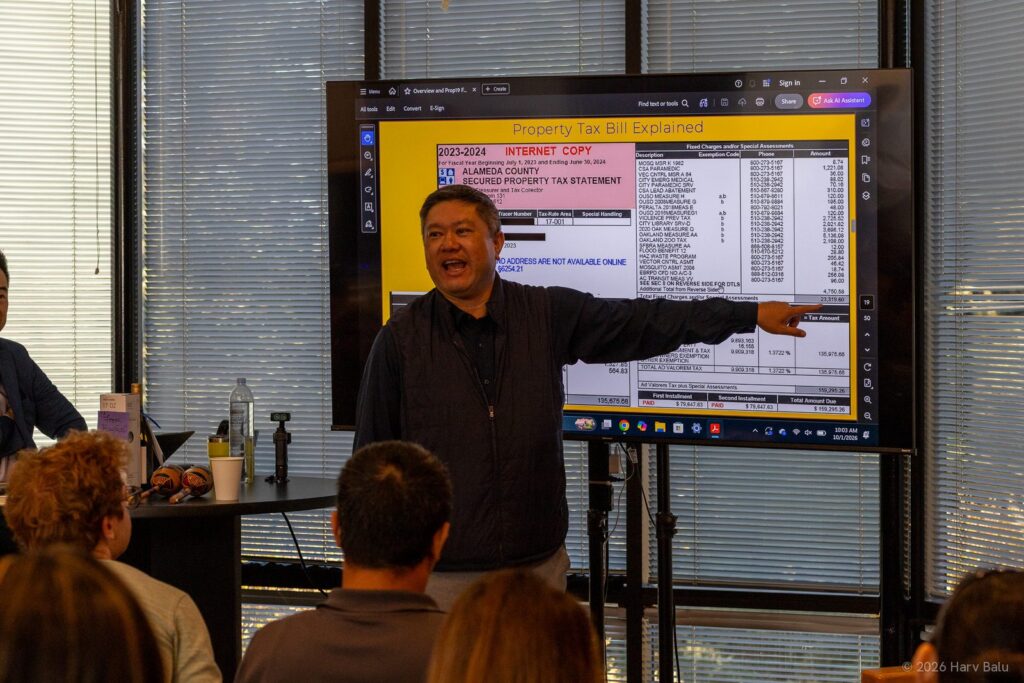
Alameda County Assessor Phong La was the guest speaker at the Tri-Cities Marketing Council, the Thursday morning group of Fremont-area real estate professionals I belong to. Phong grew up in Union City and lived in Fremont for years. He practiced real estate law, and he told us he was a Bay East member for 15 years, before voters elected him in 2018 as the county's 23rd Assessor (Assessor's Office; his bio). I brought a big lens and took the pictures, and they're at the end of this post, laid out like one of his office's parcel maps.
He opened with the county's own disclaimer, and I'll borrow it: this is education, not legal or tax advice. What follows is what I took away for buyers and sellers in Alameda County, plus what I looked up afterward in the state and county rules, so every point here traces back to a source.
The short version
- Your tax bill has two parts. The Assessor sets your home's value, and Prop 13 sets the base tax at 1% of it. Everything else on the bill comes from bonds and local measures, which is why two homes with the same value can pay different amounts.
- Buyers, budget for the supplemental bill. It arrives after closing, it comes to you, and the county's online estimator gives a rough number before you write an offer.
- Owners, a value can come down. If your home was worth less than its assessed value on January 1, the Assessor can lower it, and his office already does that for thousands of owners who never asked.
- Remodelers, replacing is different from adding. Repairs and like-for-like replacements don't raise your assessment. New square footage does, and so can a remodel that upgrades or rebuilds.
- Sellers 55 and older, your tax base can move with you. Under Prop 19 you can carry it to a replacement home anywhere in California.
- Families, passing down the family home works differently now. A child keeps the parents' low base only by moving in, and only up to a limit.
Your tax bill has two parts, and the Assessor controls only one of them
Phong had one joke for the morning, and it's a good way to remember who does what. In Alameda County's property tax mafia, he said, he's the godfather: he sets the assessed value. The Auditor-Controller is the family's accountant, who applies the tax rate. And everything on top of the 1% comes from the voters.
Here's how the pieces fit. Under Prop 13, the base tax on real property can't exceed 1% of its assessed value, and the assessed value starts at the purchase price when you buy. After that, it can rise by no more than 2% a year for as long as you own the home (California Constitution, article XIII A). The constitution also allows taxes beyond the 1% to repay bonds that voters approved, and local measures add parcel taxes and assessments. That's why the total rate differs from one part of the county to the next. Berkeley has the highest average rate, Phong said, and the lowest are in unincorporated areas such as Castro Valley, Fairview, San Lorenzo and Sunol, which don't pay for a city government.
His 1% is only one line on the bill. His example was a small business in Oakland: assessed at $200,000, it owed $2,000 under the 1%, yet its total bill was $12,000. The other $10,000, he said, came from measures voters had approved.
And the 1% itself? His slide broke down each dollar countywide: 41 cents to schools, 18 to cities, 15 to the county, 14 to successor agencies (the former redevelopment agencies) and 12 to special districts, such as water districts. The schools figure matches the county's July 2026 announcement of this year's roll, which put education's share at nearly 41% (Assessor's Office).
What this means if you're buying: don't estimate your taxes from the seller's bill. It reflects the value set when they bought, plus 2% a year at most, and in our area that can be a fraction of today's price. Your bill starts from your purchase price. A fair estimate is your price times the total rate on the home's current bill, plus the fixed charges listed on it. I pull the current bill for every home my buyers are serious about, so we can do that math before the offer, not after.
Buyers: the supplemental bill comes after you close, and escrow doesn't pay it
Phong asked the room to make sure every buyer hears this one. When a home changes hands, the Assessor reassesses it at the new value, and the change is billed separately as a supplemental assessment. Under state law (Revenue and Taxation Code sections 75.11 and 75.41):
- The amount is the difference between your new assessed value and the value already on the roll, taxed for the part of the fiscal year (July 1 to June 30) that's left.
- The clock starts on the first of the month after you close. Close on October 15, and the supplemental covers November through June.
- Close between January 1 and May 31, and you get two supplemental bills, one for the rest of the current fiscal year and one for the full year after, because next year's roll was already set at the old value on January 1.
- If you paid less than the roll value, the supplemental is negative and becomes a refund.
- If the new value looks wrong, the window to appeal a supplemental assessment is short: 60 days from the mailing date printed on the notice (section 1605).
Here's an illustration, with an assumed rate. Say you buy a Fremont home for $1,500,000 that's on the roll at $600,000, and the total rate on its current bill is 1.2% (an assumption for the example; check the real bill). The difference is $900,000, and a full year of tax on it is $10,800. Close on October 15, and the supplemental covers eight months, about $7,200. That's on top of your share of the regular bill, which escrow prorates between you and the seller.
Two details from the Assessor's Office make this easy to miss. Supplemental bills go out year-round, and most are mailed within 12 months of the sale. And unlike the annual bill, "lenders do not receive the supplemental tax bill" (Assessor's Office), so even if your loan has an impound account, the bill comes to you, with its own due dates printed on it.
The Assessor's Supplemental Tax Estimator asks for the purchase date, the price and the current roll value, and gives you a rough figure. Put it in your budget the day you go into contract. Miss the bill, Phong warned, and penalties follow.
Property tax calculator: run your numbers before you write an offer
Put in your price, the value on the roll now, the total rate on the home's current bill and the month you expect to close. The worksheet follows the county's steps for the supplemental bill, then shows your regular bill at your price. It opens on the example above.
Alameda CountyA buyer's worksheet
The bill after the bill
Estimate onlyNot a tax bill
Part 1Your numbers
In most sales, it becomes the home's new assessed value.
The seller's value: the total assessed value on the home's current tax bill, before exemptions.
The 1% base plus voter-approved bonds, printed on the same bill.
The clock starts on the first of the next month.
Part 2The bill after the bill
- Line 1: Your price, the new assessed value
- $1,500,000
- Line 2: Less the value on the roll now
- ($600,000)
- Line 3: Supplemental assessment, line 1 less line 2
- $900,000
- Line 4: A full year of tax on line 3, at 1.20%
- $10,800
- Line 5: Bill for November through June, line 4 × 0.67
- $7,236
Close in October and the clock starts November 1, so one supplemental bill covers November through June. State law puts that share of the year at 0.67. From the next tax year on, your regular bill is figured on your price.
Most supplemental bills arrive within 12 months of closing. They come to you, not your lender, and each is payable in two installments with its due dates printed on it.
Part 3Your regular bill at your price
- Line 1: Tax on your price at 1.20% a year
- $18,000
- Line 2: About this much a month
- $1,500
- Line 3: Five years after you buy, at most, at today's rate (Prop 13 caps the rise at 2% a year)
- $19,873
Add the fixed charges and special assessments on the home's current bill, including any Mello-Roos tax; they don't depend on value. Once it's your main home and you file the claim, the homeowners' exemption takes $7,000 off the value.
An estimate, not a bill. The proration factors are the ones in California Revenue and Taxation Code section 75.41. Your actual bills come from the county and can differ, for example if the Assessor's value isn't your price or the tax rate changes. For the county's own rough figure, use the Assessor's Supplemental Tax Estimator. More calculators are on my tools page.
Set aside for supplemental tax, $7,236. Regular annual tax at your price, about $18,000.
While you're at it, file for the homeowners' exemption once you've moved in. It takes $7,000 off your assessed value, which the Assessor's Office says saves about $70 to $80 a year (Assessor's Office). File by February 15 for the full exemption (calendar). The office can send a claim form for your property if you call (510) 272-3770.
Owners: if your home is worth less than its assessed value, the value can come down
Prop 13's 2% cap only limits increases. When a home's market value on January 1 falls below its Prop 13 value, the Assessor enrolls the lower value instead. That's Prop 8, and the State Board of Equalization puts it plainly: the Assessor enrolls "the lesser of the factored base year value or market value" (BOE, decline in value).
Here's the part I didn't expect. For this year's roll, his office says, staff proactively reviewed more than 50,000 parcels and reduced the values of just under 25,000 (Assessor's Office, July 2026). Phong told us those owners didn't have to ask. He gave the credit to his team, who worked Saturdays and Sundays to get through them, and said no other assessor in the state does as much.
In Fremont alone, his slide showed 1,940 Prop 8 reductions on preliminary 2026 figures: 1,610 residential, 316 mobile homes and 14 commercial properties. Phong said most of the Fremont homes on that list are condos purchased within the past five to eight years. Some have lost 20 to 30% of their value, by his account, and some condos in Oakland and Emeryville now sit 50 to 60% under where they were at the 2021 and 2022 peak.

If you think your value is still too high, here's the order Phong recommended:
- Ask informally first. The Assessor's Office takes an Informal Request for Decline in Market Value Reassessment online or on paper. It asks for at least one comparable sale that closed as close to January 1 as possible, and no later than March 31. The request for the current 2026-27 tax year is due by December 31, 2026, and you can also file for the year ahead (Assessor's Office). Phong's advice was to send three sales, from your own city. A Hayward sale won't carry weight for a Fremont home, and neither will a sale from years ago.
- Know what the informal request doesn't protect. The county's form is blunt: if you haven't heard back by the appeal deadline, or you disagree with the answer, you must file a formal appeal on time to protect your appeal rights. That appeal goes to the county's Assessment Appeals Board, through the Clerk of the Board, not the Assessor, and the regular filing period runs from July 2 to September 15, with a $50 fee per application (Clerk of the Board; section 1603).
- For this tax year, the appeal window has closed, so for most owners the informal request is the path that's left. The one exception: the county's 2026 appeal booklet allows filing as late as November 30 if you didn't receive a notice of assessed value before August 1 (2026 booklet). For next year's value, file the informal request early in 2027, and if you don't have an answer you can live with by September 15, file the appeal anyway.
- Expect the value to be reviewed every year. A Prop 8 value is reappraised each January 1. When the market comes back it can rise more than 2% in a single year, but never above your Prop 13 value, which keeps growing in the background by up to 2% a year (BOE).
If you bought a condo or townhome in 2021 or 2022 and your assessed value hasn't moved, call me. I'll pull the sales closest to January 1 in your complex and neighborhood at no cost, so you can decide whether a review is worth asking for.
Remodeling: replacing doesn't raise your assessment, but adding does
This one comes up with sellers all the time, usually right before they list.
- Normal maintenance and repair isn't new construction. The Assessor's Office lists "replacement of worn out items such as a roof or plumbing fixtures" among the work that doesn't trigger a reassessment (Assessor's Office). The state's rule names painting and new roof coverings (Property Tax Rule 463), and the Board of Equalization says even replacing a shake roof with tile isn't new construction.
- An addition is assessed, and only the addition. Adding a room, a pool or a garage is new construction, and "only the portion of the property which was newly constructed" is reassessed. Phong's example: a home assessed at $200,000 that adds a $50,000 bathroom goes to $250,000, and the rest of the home keeps its Prop 13 value. Strictly, the Assessor adds the value the work creates, "not necessarily the cost," in the state rule's words.
- A remodel can count, too. Work that brings part of a home to the substantial equivalent of new, or changes its use, such as a garage turned into living space, is new construction (section 70). The Board of Equalization lists replacing cabinets, countertops, flooring or fixtures with upgraded materials as an example, while swapping old fixtures for modern ones is not, and the Assessor decides case by case. Phong's version for the room: keeping one stud doesn't save you.
- Work without permits can come back later. The Assessor gets copies of building permits from all 14 city building departments in the county (Assessor's Office), though some arrive late, Phong said. When unreported new construction turns up after the fact, it's assessed back as an escape assessment, for the current year plus up to four prior years, and up to eight in cases of fraud or an unfiled change of ownership statement (Assessor's Office; section 532).
If you're selling, compare what's built with what's permitted before we list. An unpermitted addition is a disclosure item and a negotiation item, and I'd rather we find it first. If you're buying, your purchase price sets a new base value for the whole property, every addition included, permitted or not.
Moving: Prop 19 lets homeowners 55 and older take their tax base with them
Phong ran out of time before his Prop 19 slides, so this section is my own homework, and it matters to a lot of the sellers I talk with.
If you're 55 or older, severely disabled, or the victim of a wildfire or natural disaster, Prop 19 lets you transfer your home's Prop 13 base value to a replacement primary residence anywhere in California (section 69.6; BOE, Prop 19):
- Timing: buy or build the replacement within two years before or after you sell the original.
- Price: if the replacement costs more than a threshold, the amount over it is added to the base you carry over. The threshold is 100% of the original home's value if you buy first, 105% if you buy within a year after selling, and 110% in the second year.
- How often: up to three times for homeowners 55 and older or severely disabled.
- How to claim: file form BOE-19-B (for 55 and older) with the assessor of the county where the new home is, within three years of buying it. Escrow doesn't file it for you, so it's on you, and on me to remind you.
For a Fremont couple who bought decades ago, that can be the difference between a new home taxed near what they pay now and one taxed at full price. If you're thinking about downsizing, let's run those numbers before we price your home, so the next purchase is part of the plan.
Families: the family home keeps its low base only if a child moves in
Prop 19 also changed what happens when parents pass a home to their children, for transfers on or after February 16, 2021:
- It has to be the family home. It must have been the parent's principal residence and become a child's principal residence within one year, and the child must file for the homeowners' exemption within a year (section 63.2). Rentals and second homes are reassessed at market value.
- There's a cap. The parent's base carries over only up to that value plus $1,044,586, the adjusted figure for transfers from February 16, 2025 through February 15, 2027. Anything above it is added to the assessed value (BOE Letter To Assessors 2025/009).
- A sibling buyout is reassessed. When several children inherit and one buys out the others, the Board of Equalization's August 2026 guidance treats the share that passes between siblings as a reassessable transfer (Letter To Assessors 2026/026). Phong made the same point in the room.
- The claim has a deadline. Form BOE-19-P is generally due within three years of the transfer, or before the home is sold to someone else.
Phong also raised the income tax side, which is the one families most often miss. Property inherited at death generally takes a basis equal to its fair market value on the date of death, while property given during life generally keeps the parent's basis (IRS Publication 551). On a Bay Area home bought decades ago, that difference can mean a very large capital gains bill. Whether to transfer now or later is a question for your CPA and estate attorney, ideally before anyone signs a deed.
Thinking of leaving California for lower taxes? Ask which tax you mean
Phong's first topic was Tesla. The Fremont plant holds the city's largest real property assessment, roughly $551 million, and he said that figure is still anchored to the price Tesla paid for the factory in 2010. Does the property tax give Tesla a reason to leave? He argued the opposite: under Prop 13 the value can climb only 2% a year, while in Texas, by his account, an assessor can mark a plant up to whatever the market says, at a rate nearer 3%. When companies do leave California, he said, it's usually the headquarters that moves, and income tax is the reason. California's top personal rate is 13.3% (Franchise Tax Board), and Texas has no personal income tax (Texas Comptroller).
His advice for clients weighing a move is mine too: a family building equity and a retiree living on investment income will come out differently, so look at the whole picture with an accountant, not just the property tax bill.
What I'm doing differently after this talk
- Every buyer budget gets a supplemental estimate, from the county's estimator, before we write an offer.
- Every listing gets its current tax bill pulled, so buyers can see what their own bill will be built from: their price, not the seller's.
- Owners who bought condos or townhomes in 2021 or 2022 get a call from me, with the sales closest to January 1 in their complex, so they can decide whether to ask for a review.
- Before a listing goes live, I compare permits with what's built, so an addition doesn't turn into a surprise in escrow.
- For sellers 55 and older, the Prop 19 transfer is part of the pricing conversation, not an afterthought.
- When a family inherits a home, the CPA and the estate attorney come in early, before a buyout or a sale is decided.
Alameda County property tax dates to keep
- January 1: the lien date. Your value for the coming tax year is set as of this date, and it's the date a decline in value review measures against.
- February 15: the deadline to file the homeowners' exemption for the full amount.
- Mid-July: the Assessor mails every owner a notice of the year's assessed value. Read it; it's the number your bill is built on.
- July 2 to September 15: the regular window to file a formal appeal with the Assessment Appeals Board.
- October: annual tax bills go out.
- November 1: the first installment is due, and it's delinquent after 5:00 PM on December 10, when a 10% penalty attaches.
- December 31: the deadline for this tax year's informal decline in value request. It doesn't extend the appeal deadline.
- February 1: the second installment is due, and it's delinquent after 5:00 PM on April 10, when a 10% penalty and a $10 charge attach.
- Supplemental bills: mailed year-round, most within 12 months of a sale, with their own due dates printed on each bill.
Sources: the Assessor's calendar of important dates and the Treasurer-Tax Collector's property tax questions.
Hear it from Phong
The council streamed the meeting on Facebook Live, and Phong covers more than fits here, including a question from the floor about rebuilding a home before moving in. The council's recap of the morning links to the recording, and Phong's talk starts about 37 minutes in. His office is online at acassessor.org.
The morning, parcel by parcel
I took these pictures that morning. They're laid out the way an assessor's map draws a neighborhood: every photo is a numbered parcel, the blocks follow the course of the morning, and the streets take their names from the talk. Open any parcel to see it full size.
Tri-Cities Marketing Council, FremontThursday, October 1, 2026
One morning, mapped
Map bookBk 10 · Pg 01
Photographs by Harv Balu. Select a parcel to open it; the arrow keys move between them.
Thank you, Phong
Thank you, Phong, for half an hour of plain answers about an office that touches every sale I handle, and thank you to your staff for the weekends they spent on those reductions. Thank you as well to Chuck Edell for the room we meet in.
The Tri-Cities Marketing Council meets Thursday mornings in Fremont, and guests are welcome. You can see who's speaking next on the council's speaker calendar.
If you're buying or selling in Fremont, Newark, Union City or Hayward and want to know what your property taxes will really look like, call or text me at (510) 600-3425, or email homes@HarvRealtor.com. I'll pull the current bill, run the supplemental estimate, and walk you through both.
Harv Balu, REALTOR®
- Cell / Text: (510) 600-3425
- Email: homes@HarvRealtor.com
- Web: HarvRealtor.com
- REALTY EXPERTS® · 41051 Mission Blvd, Fremont, CA 94539 · DRE #02195792
Disclosures
This post is general education for consumers, not legal or tax advice. Harv Balu is a licensed REALTOR®, not an attorney, accountant or appraiser. Property tax rules change, and how they apply depends on the facts of each property, so confirm anything that affects you with the Alameda County Assessor's Office, the Treasurer-Tax Collector or a qualified tax professional. The dollar example uses an assumed rate and is an illustration, not an estimate for any property. The calculator works only from the figures you enter, and the county's bills can differ. Statements attributed to Phong La are from his presentation to the Tri-Cities Marketing Council on October 1, 2026; his appearance does not imply any endorsement of me or my business by the Assessor's Office. Legal references are summarized from the California Constitution, the Revenue and Taxation Code, the State Board of Equalization, the IRS and the Franchise Tax Board, as of October 2026.
Photographs by Harv Balu, taken at the meeting.
Equal Housing Opportunity. Harv Balu, CA DRE #02195792. REALTY EXPERTS® (CA DRE #00414413) is independently owned and operated. © 2026 Harv Balu, REALTY EXPERTS®.
Alameda County property taxes: common questions
What is a supplemental property tax bill in Alameda County?
When a home sells, the Alameda County Assessor reassesses it as of the date of the sale. The supplemental bill taxes the difference between the new assessed value and the value already on the tax roll, for the months left in the fiscal year, which runs July 1 to June 30. Proration starts on the first day of the month after the sale. If you close between January 1 and May 31 you receive two supplemental bills, one for the rest of the current year and one for the full next year. Most supplemental bills are mailed within 12 months of the sale, and they go to the owner, not the lender, so even an impound account will not pay one automatically. Buyers should set the money aside. The county's Supplemental Tax Estimator gives a rough figure from the purchase date, price and current roll value.
How much will my property taxes be after I buy a home in Alameda County?
Your assessed value starts at your purchase price. The base tax is 1% of that value under Prop 13, and voter-approved bond rates for that location are added, along with any fixed charges and special assessments listed on the current bill. A practical estimate is your price times the total rate on the home's current tax bill, plus its fixed charges. Do not rely on the seller's bill, which reflects the value set when they bought. In the first year you will also receive a supplemental bill for the change in value.
How do I ask the Alameda County Assessor to lower my assessed value?
If your home's market value on January 1 was below its assessed value, file an Informal Request for Decline in Market Value Reassessment with the Alameda County Assessor's Office, online or on paper, with at least one comparable sale that closed as close to January 1 as possible and no later than March 31; Assessor Phong La suggested three from your own city. The request for the 2026-27 tax year is due by December 31, 2026. An informal request does not protect your appeal rights: the county's form says that if you have no response by the appeal deadline, or you disagree with it, you must file a timely formal appeal with the Assessment Appeals Board, whose regular filing period is July 2 to September 15. That window has closed for 2026-27, so for next year's value, file the informal request early in 2027 and appeal by September 15 if you need to. A reduced value is reviewed every January 1 and can rise by more than 2% in a year when the market recovers, but never above your Prop 13 value.
When is the deadline to file a property tax appeal in Alameda County?
For a regular assessment, the filing period with the Alameda County Assessment Appeals Board runs from July 2 to September 15 each year, the period in California Revenue and Taxation Code section 1603, and the county charges a $50 fee per application. The 2026 regular window has closed. The county's 2026 appeal booklet adds that an owner who did not receive a notice of assessed value before August 1 may file as late as November 30. An appeal of a supplemental or escape assessment has its own deadline: 60 days from the date of mailing printed on the notice.
Does remodeling raise my property taxes in California?
Normal maintenance and repair, such as painting or replacing roof coverings, is not new construction and does not change your assessment. An addition is assessed at the value it adds, which is added to your existing Prop 13 value, while the rest of the home keeps its value. A remodel can also count as new construction if it brings part of the home to the substantial equivalent of new or converts it to a different use; the State Board of Equalization lists replacing cabinets, countertops, flooring or fixtures with upgraded materials as an example, and the assessor decides case by case. New construction that was never reported, including unpermitted work, can be assessed back for the current year plus up to four prior years, and longer in cases of fraud or an unfiled change of ownership statement.
Can I keep my Prop 13 tax base if I sell my home and buy another one in California?
Under Proposition 19, homeowners 55 or older, severely disabled homeowners, and victims of wildfire or natural disaster can transfer their base year value to a replacement primary residence anywhere in California. The replacement must be bought or built within two years before or after the original is sold. If it costs more than 100%, 105% or 110% of the original home's value, depending on timing, the amount over that threshold is added to the transferred value. Homeowners 55 and older and severely disabled homeowners can use it up to three times. The claim, form BOE-19-B for 55 and older, is filed with the assessor of the county where the replacement home is, within three years.
Can my children keep my Prop 13 tax base if they inherit my house?
Only for the family home, and only up to a limit. For transfers on or after February 16, 2021, the home must have been the parent's principal residence and must become a child's principal residence within one year, and the child must file for the homeowners' exemption within a year. The parent's factored base year value carries over up to that value plus $1,044,586 for transfers from February 16, 2025 through February 15, 2027; anything above is added. Rentals and second homes are reassessed, and the State Board of Equalization treats the share one sibling buys from another as a reassessable transfer. Ask a CPA and an estate attorney about income tax basis before any deed is signed.

Harv Balu
REALTOR® | GRI, CIPS, PSA, FTBS · REALTY EXPERTS®
CA DRE# 02195792
Read every post in HarvRealtor, my free app, and the words read offline. Download it free from the App Store® (opens in new tab).